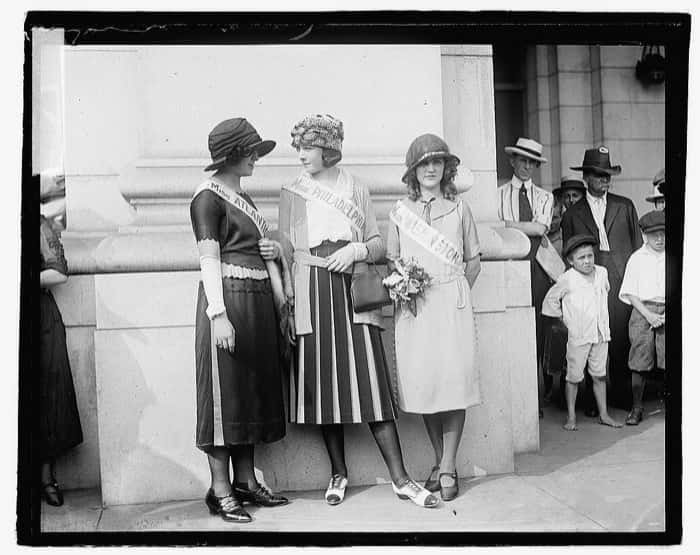
What started as a clever marketing ploy wound up becoming one of America's most enduring cultural institutions—a dazzling blend of beauty, spectacle, and tradition. On September 7, 1921, the very first Miss America Pageant unfolded in Atlantic City, New Jersey.
A Tourism Strategy
Atlantic City had built its reputation as a premier resort destination in the early 20th century. The problem? Once Labor Day passed and summer unofficially ended, tourists packed up and headed home in droves. Determined to extend the season, city leaders hatched a plan: an "Inter-City Beauty Contest" designed to keep visitors strolling the Boardwalk just a bit longer by crowning the most beautiful young woman from a selection of northeastern cities.
Young women were invited to represent their hometowns, and photographs poured in from across the country. In the end, only ten finalists were selected—still the smallest contestant pool in the pageant's entire history.
The Contestants
The women who competed hailed from Newark, Camden, Philadelphia, Pittsburgh, Harrisburg, New York City, Ocean City, and Washington, D.C. Playing the role of hostess was Miss Atlantic City, the local representative—a tradition that would endure for decades to come.
Contestants were evaluated in several ways: they modeled stylish afternoon attire, engaged with the public, and later took part in the Bather's Revue, showcasing fashionable swimwear. Judging blended official scores with audience opinion, giving the whole affair a unique mix of formal competition and crowd-driven spectacle.
Margaret Gorman Takes the Crown
Margaret Gorman, a 16-year-old from Washington, D.C., walked away with the victory and the Golden Mermaid trophy. She also claimed the Watkins Trophy for amateur beauty and would later return to compete under a brand-new title—"Miss America"—the first time that now-iconic name was ever used.
Kathryn Gearon of Camden earned the runner-up spot, while Virginia Lee of New York City, already known as a silent film actress, took home the professional division's Endicott Trophy.
More Than a Beauty Contest
Beauty was only part of the equation—the whole event had the festive energy of a carnival. A spectacular parade wound through the festivities, featuring floats backed by local businesses and civic groups. Even the Atlantic City Free Public Library got in on the action, entering a float designed as a miniature library staffed with costumed young people who represented literature, medicine, and genealogy.
The pageant struck a chord with the public almost immediately. Glamour, hometown pride, and widespread media attention turned it into an overnight sensation—guaranteeing its return the following year and its evolution into a beloved national tradition.