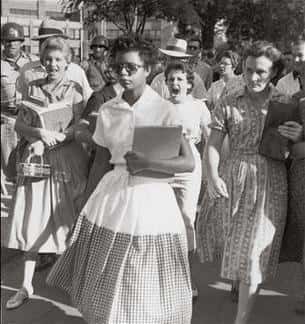
America's long struggle for civil rights is defined by a handful of watershed moments, and few rival the dramatic events that began on September 4, 1957, in Little Rock, Arkansas. On that day, Governor Orval Faubus took the extraordinary step of deploying the National Guard to physically prevent nine Black students from setting foot inside Little Rock Central High School. This direct challenge to the U.S. Supreme Court's landmark desegregation ruling in Brown v. Board of Education quickly spiraled into a full-blown national crisis, forever shaping the trajectory of the civil rights movement.

Fun Facts:
- By ordering the Arkansas National Guard to physically bar nine Black students from Little Rock Central High School, Governor Orval Faubus threw down a direct challenge to the Supreme Court's Brown v. Board of Education (1954) ruling, which had declared the desegregation of public schools to be the law of the land.
- Known collectively as the Little Rock Nine, the students—Ernest Green, Elizabeth Eckford, Jefferson Thomas, Terrence Roberts, Carlotta Walls, Minnijean Brown, Gloria Ray, Thelma Mothershed, and Melba Pattillo—emerged as towering symbols of the civil rights cause. Facing fierce opposition at every turn, they demonstrated extraordinary courage, an unyielding insistence on their right to an education, and a refusal to back down that proved both instrumental and deeply inspiring in the broader fight for racial equality.
- Beyond gripping the American public, the standoff drew the eyes of the world, shining an international spotlight on the deep-seated resistance to desegregation across the South. This global attention put immense pressure on the federal government to enforce the rule of law and safeguard the rights of Black citizens, underscoring how far-reaching the civil rights movement's influence truly was.
- Faced with an escalating crisis, President Dwight D. Eisenhower ultimately stepped in on September 25, 1957, dispatching federal troops to personally escort the students through the doors of the school, thereby guaranteeing their safety and enforcing the desegregation order.
- Impact on Civil Rights Movement: The standoff in Little Rock laid bare just how formidable the obstacles to desegregation remained across the United States. It served as a powerful catalyst for the civil rights movement, fueling a surge in activism that would ultimately contribute to the passage of the Civil Rights Act 1964.
- Legacy: The courage displayed by the Little Rock Nine endures as one of the most revered chapters in the civil rights story—a potent symbol of the struggle against racial segregation and the continuing pursuit of equal access to education.