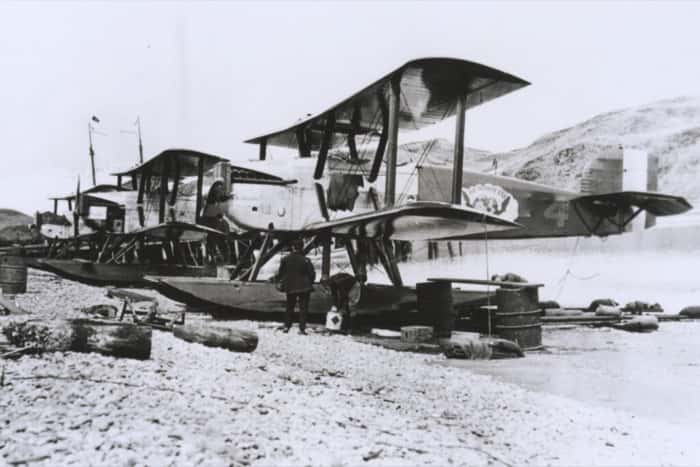
What would it take to fly around the entire planet in 1924? No radios. No GPS. No sophisticated instruments. Just maps, dead reckoning, a healthy dose of luck—and four specially built biplanes crewed by some of the bravest aviators you've never heard of. On September 28, 1924, two of those planes touched down in Seattle, and four U.S. Army Air Service flyers stepped into history as the first people to circumnavigate the globe by air. It was a moment that forever changed how humanity thought about distance, flight, and what was possible.
The Race to Circle the Globe
By the early 1920s, an around-the-world flight had become aviation's ultimate prize—and multiple nations were hungry to claim it. The British gave it a shot in 1922. The French followed in 1923. Both the Italians and Portuguese were drawing up their own plans. Not to be outdone, the U.S. Army Air Service resolved that America would be the one to pull it off.
But ambition alone wouldn't get anyone off the ground—they needed an aircraft built for the challenge. That's where Donald Douglas came in. He took his reliable DT-2 torpedo bomber and reimagined it as something entirely new: the Douglas World Cruiser. The design featured interchangeable wheels and pontoons, along with fuel tanks capable of pushing its range beyond 2,000 miles. Four of these machines were delivered in early 1924, each christened after an American city: Seattle, Chicago, Boston, and New Orleans.
Into the Unknown
On April 6, 1924, the four planes lifted off from Seattle, embarking on a 175-day odyssey that would stretch over 26,000 miles and carry their crews through 28 countries. With no radios or advanced instruments aboard, the aviators relied entirely on dead reckoning, maps, and sheer luck to find their way. Trouble arrived fast. Expedition commander Major Frederick Martin, piloting the Seattle, crashed into fog along the Alaskan coast. Martin and his mechanic walked away alive, but the plane was destroyed. Down to three aircraft, the mission pressed on under the leadership of Lieutenant Lowell Smith and First Lieutenant Leslie Arnold, flying the Chicago.
From the Aleutians, they pushed into Soviet territory, then threaded through Japan and swept southward across Asia. The flyers endured crashes, mechanical breakdowns, and relentless monsoon rains. In Vietnam, the Chicago found itself stranded in a lagoon—its pilots surviving on food brought by missionaries and locals while they waited for a replacement engine. The Atlantic crossing proved equally perilous: the Boston went down at sea, its crew pulled to safety by a U.S. Navy cruiser. The plane itself, taken under tow through heavy seas, capsized and was lost for good.
Homecoming in Seattle
Only two aircraft remained—the Chicago and the New Orleans. Together they pushed across Europe, over Greenland, and through Canada before finally arriving back in Seattle on September 28, 1924, to a rapturous welcome. More than 100,000 people turned out to greet them. All told, the expedition had logged 363 flying hours and demanded countless displays of skill and raw determination.
Overnight, the surviving airmen—Smith, Arnold, Erik Nelson, and John Harding Jr.—became national heroes. Congress honored them with the Distinguished Service Medal, the first time it had ever been bestowed for a peacetime achievement. The feat also earned them the Mackay Trophy for 1924, permanently securing their place in the annals of flight.
Why It Mattered
This expedition proved something profound: the airplane was no longer just a battlefield weapon or a daredevil's toy. It was a vehicle capable of knitting the world together. The Douglas Aircraft Company wasted no time capitalizing on the achievement, adopting the proud slogan, "First Around the World – First the World Around." Within a generation, commercial airlines would bridge oceans and military bombers would range across continents. But in 1924, it all started with four young men in open-cockpit biplanes who showed the world, once and for all, that the sky had no limits.