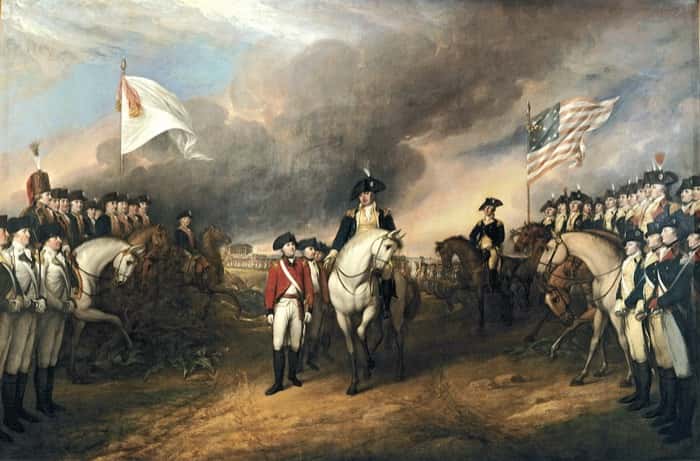
British dominance during the American Revolution came crashing down at the Siege of Yorktown. It was September 28, 1781, when American and French troops — bound together by a vital alliance — united their forces and launched a siege against Yorktown, Virginia. This would prove to be the decisive confrontation that ultimately paved the way for American independence.
Fun Facts:
- People often call the Siege of Yorktown by another name: the Battle of Yorktown.
- On September 28, 1781, the combined American and French armies set out for Yorktown, Virginia, marching under the joint command of General George Washington and French General Rochambeau, driven by a shared determination to achieve victory.
- By most estimates, the American side fielded about 3000 fighting men, while the British could muster roughly 5000.
- General Charles Cornwallis and his British troops found themselves in an increasingly desperate predicament at Yorktown. Pinned against the York River with nowhere to flee, the British were completely cut off — a situation that handed an enormous strategic edge to the combined American and French forces.
- The role of the French navy cannot be overstated. By establishing a strategic blockade that prevented British ships from reaching Yorktown, French naval forces proved just how profoundly international support shaped the outcome of the American Revolution.
- For 21 grueling days, the siege ground on, as unrelenting artillery bombardments steadily dismantled British defensive positions.
- At precisely 10:30 a.m. on October 19, 1781, the forces under Cornwallis formally laid down their arms in surrender, bringing major combat operations in the American Revolution to an effective close.
- The triumph at Yorktown and the subsequent British surrender directly led to the Treaty of Paris in 1783. This landmark agreement formally acknowledged American independence and drew the boundaries of the newly formed nation. As a direct consequence of the Siege of Yorktown, the treaty didn't just conclude the war — it represented a defining moment in the story of America.