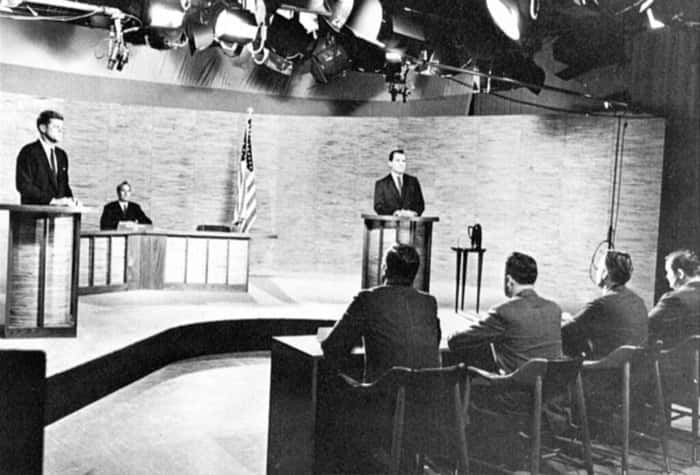
While American history is no stranger to various forms of presidential discourse and debate, the encounter that took place on September 26th, 1960 is widely considered the first to resemble the presidential debates we know today. In the thick of a heated election season, John F. Kennedy and Richard Nixon agreed to face off in a series of four televised debates, broadcast directly into the living rooms of the American people. Their goal was clear: tackle the most divisive issues of the day and win over voters who hadn't yet made up their minds. Going into that first September 26th showdown, Nixon held the edge in the polls. Yet a combination of factors — notably his lack of experience with the television medium and his physical appearance — ultimately led most to declare John F. Kennedy the victor. Those four debates during the 1960 election season established the blueprint for modern presidential debates, which are now seen as an essential part of every campaign cycle.
Fun Facts:
- Following the debates, John F. Kennedy went on to win the presidency, becoming the 35th president of the United States and bringing Lyndon B. Johnson along as his second in command.
- Richard M. Nixon had previously served as the 36th vice president of the United States under Dwight D Eisenhower, and he would eventually go on to win the White House himself as the 37th president.
- Nixon's physical condition was hard to miss during the debate — he was visibly 20 pounds underweight after spending a few weeks in the hospital recovering from knee surgery. Compounding matters, he chose not to wear makeup, making his gaunt appearance even more pronounced and offering a powerful lesson in how visual presentation can shape public opinion in the age of television.
- Kennedy, by contrast, had been out on the campaign trail in California for a few weeks beforehand, picking up a healthy tan that gave him a youthful, well-rested glow on screen.
- Moderating the debate in Chicago, Illinois was Howard Kingsbury Smith, a well-regarded journalist and broadcaster who hailed from Louisiana. His professionalism and even-handedness played a key role in keeping the proceedings fair and substantive.
- Domestic policy dominated the conversation, a reflection of what mattered most to everyday Americans at the time. Among the 77 million viewers who tuned in, many gave Nixon the nod for his deep knowledge and seasoned grasp of the issues. Still, his exhausted, worn-down appearance left a lasting impression of unease, underscoring just how much image and presentation were beginning to matter in the political arena.
- Together, the four debates leading up to the 1960 presidential elections paved the way for Kennedy's triumph and established a template for all future presidential debates in the United States. They ushered in a new chapter in political communication, fundamentally reshaping how candidates craft their public image, engage with key issues, and interact with the media. That lasting influence makes the 1960 debates a watershed moment in American political history — one whose echoes are still felt today.