It's a common misconception that World War II came to a definitive close when Germany laid down its arms in May 1945. In reality, the fight against Japan raged on for months beyond Germany's unconditional surrender. The conflict in the Pacific was its own separate theater of war, entirely distinct from the European campaign, and Germany's defeat did nothing to bring it to a halt. What followed included some of the most catastrophic bombings the world had ever seen. The war finally reached its true conclusion on September 2, 1945, when Japan put pen to paper on the formal surrender documents presented by the Allied Powers — a date we now remember as V-J Day.
Reasons for Continued Fighting
Even though Germany's unconditional surrender left no doubt about the overwhelming strength of the Allied Powers, Japan had compelling motivations to keep waging war.
- Japanese leaders were deeply worried about the survival of their state and the potential diminishment of their Emperor. The prospect of their culture being dismantled was something the nation simply could not accept.
- Surrender carried a profound sense of shame within Japanese culture, regardless of how dominant the Allied Powers had proven themselves to be.
- Japan held onto the belief that its continued reliance on suicide bombings as a war tactic would gradually exhaust the Allied Powers, eventually opening the door to more favorable peace terms.
- The Manhattan Project remained entirely unknown to the Japanese, and they were convinced that only a land invasion by the Allied Powers could bring about their defeat — a scenario they considered unlikely.
Reasons for Surrender
Japan's path to eventual surrender was driven by a tangled web of factors that reached a critical mass in August 1945. That said, the prolonged struggle against the Allied nations had already been grinding the country down well before that pivotal month.
- The United States unleashed an atomic bomb dubbed "Little Boy" on Hiroshima on August 6, 1945. Just three days later, a second bomb — this one called "Fat Man" — fell on Nagasaki. The toll on the Japanese people was catastrophic, with massive loss of life and entire cities reduced to rubble. Beyond the physical devastation, these attacks demolished the confidence of Japan's leadership in their capacity to wage war on anything resembling equal terms with the United States.
- The Soviet Union launched an invasion of Manchukuo, a Japanese puppet state, on August 8, 1945. This move proved pivotal in pushing Japan toward surrender. Japanese leaders had been banking on the Soviet Union — bound by a neutrality pact — to serve as an intermediary who might secure them better terms with the Allies. Instead, the Red Army swiftly and decisively crushed the Japanese Army. In the end, the specter of a Soviet invasion frightened Japan far more than the possibility of an American one.
Japan's Unconditional Surrender
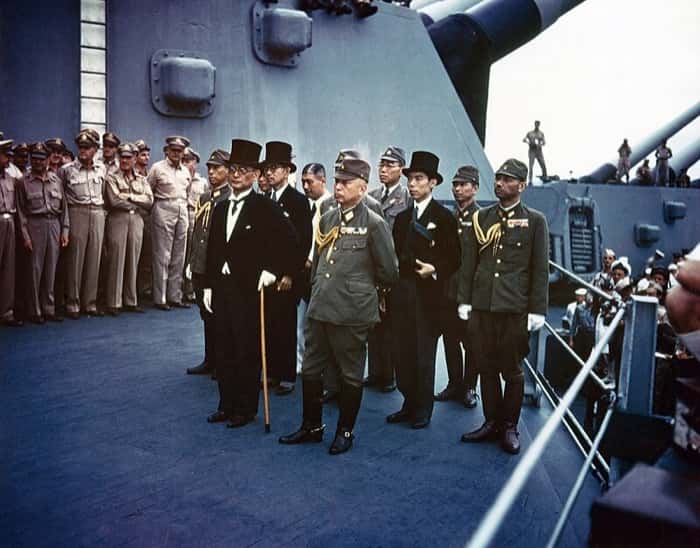
Reeling from the devastating blows dealt by both the United States and the Soviet Union, Japan found itself in a state of rapid collapse. Despite mounting pressure from every direction to act, the country still clung to its resistance against surrendering. It was Emperor Hirohito who finally determined that accepting the Allies' surrender terms was the sole path to preserving both the imperial house and the state itself. On September 2, 1945, Japanese officials signed the Instrument of Surrender aboard the USS Missouri, anchored in Tokyo Bay. With that formal signing, the war and all hostilities between the nations were at last brought to an end.