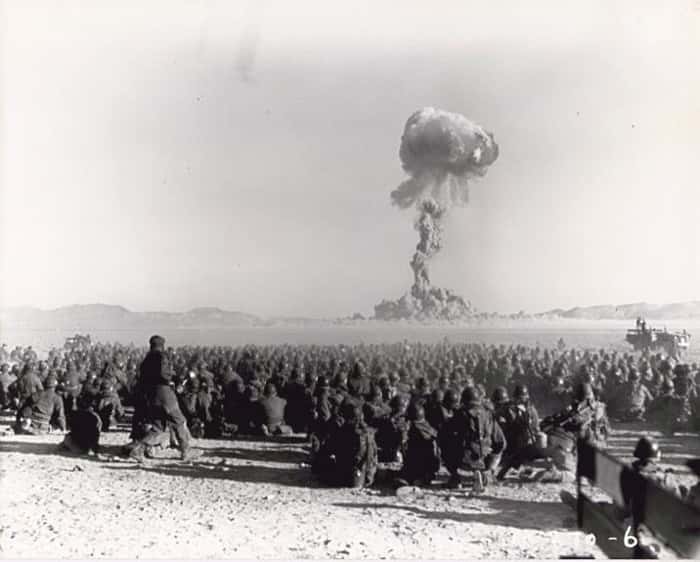
At the height of Cold War paranoia, as the nuclear arms race pushed the world's superpowers into an ever-more-dangerous competition, the United States was on the hunt for ways to test its growing arsenal without putting civilians at risk. That quest led to a landmark moment on September 19, 1957, when the country pulled off the Rainier Event — the first nuclear test ever to be fully contained underground.
The Lead Up
Both the Soviet Union and the United States were locked in a relentless drive to build increasingly sophisticated and tactically versatile nuclear weapons. But there was a massive catch: how do you test devices of such devastating power without endangering human lives? Safe testing had become one of the most pressing challenges of the arms race.
That challenge came into sharp focus in 1954, when the United States carried out Operation Castle, a series of nuclear tests. The very first blast in the series — Castle Bravo — produced fallout far exceeding predictions, spreading contamination into areas occupied by Japanese civilians and U.S. servicemen alike. The backlash was swift and intense. The National Academy of Sciences demanded tighter regulations and more rigorous safety measures for atomic testing, while scientists doubled down on their search for safer ways to detonate these weapons.
Operation Plumbbob
In the wake of what many saw as the failure of Operation Castle, researchers began aggressively pursuing alternatives that could reduce fallout. They experimented with detonations from elevated drop zones, tried balloon-based delivery methods, and investigated the possibility of setting off nuclear devices beneath the earth's surface. Out of this effort came Operation Plumbbob — a controversial series of tests the United States ran from May to October 1957, designed to evaluate new nuclear designs through underground testing.
Roughly 18,000 United States service members took part in Operation Plumbbob at a nuclear testing site in Nevada. The objectives were wide-ranging: studying how blasts affected both civil and military structures, developing tactics for operating within a nuclear blast zone, creating safety protocols in case explosive components were accidentally detonated, and putting newly developed nuclear weapons and detonation methods through their paces.
The Rainier event took place on September 19, 1957, as one component of Operation Plumbbob. During this military exercise, a nuclear device was set off deep inside a tunnel at the Nevada testing site. It was hailed as a success — the detonation's fallout was effectively contained, proving that underground testing offered a practical and far safer path forward for evaluating new nuclear devices.
Impact
What made Rainier so groundbreaking was that it achieved something no previous nuclear test had: complete containment of the explosion. Not a trace of radioactive fallout escaped into the atmosphere. This was a powerful demonstration that detonating nuclear weapons underground represented a dramatically safer approach to explosives testing.
Beyond its immediate success, the Rainier event gave scientists a rare window into how underground explosions interact with geological formations — research that would go on to shape the trajectory of nuclear testing and arms control for years to come.