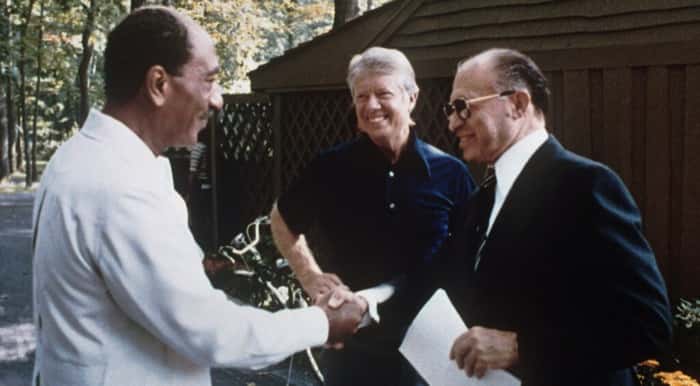
Following nearly two weeks of grueling deliberations at the presidential retreat in Maryland, the Camp David Accords were signed on September 17, 1978, by Egyptian President Anwar Sadat, Israeli Prime Minister Menachem Begin, and U.S. President Jimmy Carter. What emerged was a landmark agreement that laid the foundation for peace between Egypt and Israel.
The Road to Camp David
Egypt and Israel had been locked in fierce hostility ever since the Six-Day War in 1967, a rivalry that erupted again during the 1973 Yom Kippur War. While that conflict inflicted deep wounds on both sides, it also exposed the futility of purely military approaches. When U.S. President Jimmy Carter entered office in 1977, he made achieving peace in the Middle East a central pillar of his foreign policy agenda.
From the outset, the path to negotiations was anything but straightforward. Begin, at the helm of Israel's Likud Party, showed deep reluctance to exchange territory for peace — especially when it came to the West Bank and Gaza. Then, in November 1977, Sadat made a move that stunned the international community: he traveled to Jerusalem and spoke directly before the Israeli Knesset, making clear his readiness to pursue peace. Yet this bold gesture also deepened rifts across the Arab world, and frustration mounted over the lack of progress.
By mid-1978, momentum had ground to a halt. Sensing that a rare window for peace was closing, Carter extended an invitation to both leaders to join him at Camp David in September for a concentrated, high-stakes summit.
Twelve Days of Negotiation
Running from September 5 to 17, 1978, the Camp David talks pushed all parties to their limits. Carter threw himself into the process, frequently shuttling between separate sessions with Sadat and Begin whenever face-to-face discussions collapsed. Two overarching challenges dominated the agenda: what would become of the Sinai Peninsula, and what form Palestinian autonomy might take in the West Bank and Gaza.
Tensions ran extraordinarily high throughout. Sadat insisted on a full Israeli pullback to the 1967 borders, while Begin dug in against giving up territory and freezing settlements. Acting as tireless mediators, Carter and his Secretary of State, Cyrus Vance, crafted draft after draft, revising proposals again and again in search of common ground.
When the summit finally concluded, two framework agreements had been signed. One set out principles for Palestinian self-government in the West Bank and Gaza, though its specifics remained vague and deeply contested. The other established the blueprint for an Egyptian-Israeli peace treaty — encompassing a phased Israeli withdrawal from the Sinai along with Egypt's formal recognition of Israel.
A Breakthrough for Peace
There's no overstating the diplomatic significance of the accords. For the first time ever, an Arab nation officially recognized Israel, shattering a barrier that had defined Middle Eastern politics for decades. For Carter personally, the achievement stood as the crowning moment of his foreign policy efforts, demonstrating what American diplomacy could accomplish in bridging the divide between longstanding adversaries.
Yet the accords were far from a complete solution. Across the Arab world, many nations condemned Sadat for negotiating a separate peace, and the Palestinian issue lingered without resolution. Even so, what was agreed upon at Camp David provided the critical groundwork for the 1979 Egypt-Israel Peace Treaty, which officially brought decades of hostilities between the two countries to an end.