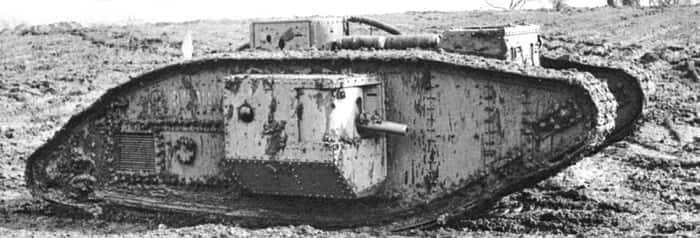
On September 15, 1916, warfare changed forever when tanks rolled onto the battlefield for the very first time. Behind a veil of strict secrecy, the British Army had spent the previous year quietly engineering these revolutionary machines. The Western Front had ground to a brutal stalemate — trench warfare pinned both sides in defensive positions while casualties mounted relentlessly. What the world needed was something that could punch through enemy lines and restore mobility to the fight, and that something was about to make its dramatic debut.
Back in the fall of 1915, the first fully realized tank prototype had come together. Its creators dubbed it "Little Willie," borrowing a derisive nickname that the British press had coined for Germany's Crown Prince Wilhelm. Following that came "Mother," a second prototype featuring a larger rhomboidal track along with weaponry. Engineers refined that design further, and by February 1916, the Mark I was born. It came in two distinct variants: the 'male,' which packed heavy firepower capable of smashing enemy fortifications, and the 'female,' outfitted with smaller guns designed to engage enemy infantry.
Trench warfare didn't end with the Mark I, but the deadlock finally started to crack. At Flers-Courcelette, the British had ambitious plans to deploy 49 tanks in the assault — yet when the moment arrived, a mere 15 were actually battle-ready. Even so, those few machines left a profound psychological mark on the German forces, showcasing the raw power and influence of this unprecedented weapon. Some soldiers reportedly fled or threw down their arms and surrendered the moment they caught sight of the hulking machines — a vivid testament to the terror and awe they provoked. Mechanical breakdowns plagued some of the vehicles, others became hopelessly mired on the torn-up battlefield, and synchronizing their movements with infantry proved a real headache. Still, their mere presence on the field was enough to change everything.
Growing pains aside, the Mark I proved to be a resounding triumph. Rather than being discouraged by the difficulties, the British Army took the hard lessons from Flers-Courcelette and used them to make improvements, while other nations rushed to develop their own tank programs. Tanks alone didn't bring WWI to a close, but they permanently transformed the nature of the battlefield — standing as a powerful testament to the British Army's adaptability and resilience, leaving all who witnessed their achievements both inspired and deeply impressed.