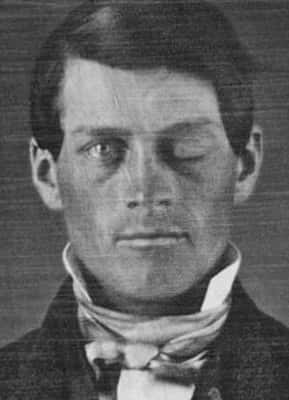
What would you do if an iron rod blasted clean through your skull—and you lived to tell the tale? That's exactly what happened to Phineas Gage, a young railroad foreman who endured one of the most remarkable accidents ever recorded in medical history on September 13, 1848. While working at a blasting site for the Rutland & Burlington Railroad near Cavendish, Vermont, a tamping iron launched through his cheek, tore through his brain, and exited from the top of his head. Against all odds, he survived and went on to live for nearly 12 more years.
The Accident
The explosion occurred at about 4:30 p.m., as Gage was packing blasting powder into a drilled hole and a spark set off the charge. The iron rod—measuring 3.2 cm in diameter and over a meter in length—erupted upward with tremendous force, piercing the left side of his face, passing behind his eye, and bursting through the top of his skull. It was later found some 80 feet away, "smeared with blood and brain."
What happened next defied all expectations. Gage didn't die on the spot. In fact, reports say he was speaking within moments, walked with only minimal help, and even remained sitting upright throughout the wagon ride into town. When local physician Edward H. Williams arrived on the scene, he discovered Gage seated in a chair, calmly recounting the incident to the people gathered around him.
Treatment and Survival
Care of the injured man fell to Dr. John Martyn Harlow, who confronted a gruesome sight: a gaping wound through which brain tissue could be seen visibly pulsating. Harlow meticulously cleaned the area, extracted bone fragments, and made the unusual choice to leave the wound partially open for drainage—a decision that very likely prevented a fatal infection.
The days that followed were harrowing. Gage drifted in and out of delirium and came dangerously close to dying from infection. Yet slowly, he pulled through. By November, he had regained enough strength to walk and take on light work. That he survived at all—let alone for another 12 years—was nothing short of extraordinary in an era that predated antiseptics or antibiotics.
Personality Changes
Gage's survival alone would have secured his place in medical history, but what truly made his case groundbreaking were the dramatic behavioral shifts that followed the accident. Prior to that fateful day, he had been regarded as a capable, responsible foreman who earned the admiration of both his workers and his employers. Afterward, however, he was described as irreverent, impatient, and profane—so transformed that, as Dr. Harlow wrote, those who had known him declared he was "no longer Gage."
Today, modern interpretations point to damage in his frontal lobe as the likely cause, disrupting his capacity for emotional regulation and decision-making—and underscoring how deeply the brain shapes who we are as people.
His case went on to become one of the earliest and most celebrated pieces of evidence connecting brain injury to changes in behavior.
Later Life
Returning to railroad work proved impossible for Gage. Instead, he spent a period making public appearances before eventually taking a job as a stagecoach driver in Chile—a role that some scholars believe helped him regain a degree of social functioning and stability.
His final years were spent living with family in California, where he was plagued by seizures. Phineas Gage died in 1860, at the age of 36.
Today, his skull and the tamping iron that changed his life are preserved and on display at Harvard's Warren Anatomical Museum—enduring symbols of both medical curiosity and human resilience.
More than 175 years after that fateful afternoon, the story of Phineas Gage continues to stand as a cornerstone in the study of brain function, a vivid testament to both the fragility and the remarkable resilience of the human mind.