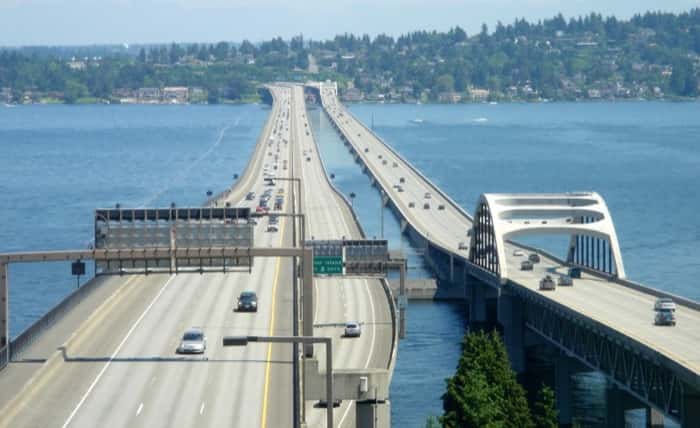
On September 12, 1993, Seattle witnessed a milestone moment when the Lacey V. Murrow floating bridge once again welcomed traffic. This reopening marked the culmination of a $93 million reconstruction effort that had stretched over three years. The bridge's history runs deep — it originally debuted in 1940 as Seattle's first floating bridge and a groundbreaking achievement in engineering, being the first ever constructed using reinforced concrete pontoons. With its 1993 reopening, the structure took on new significance as the last missing link in the I-90 highway corridor stretching from Seattle to Boston. Its purpose remains connecting Seattle to the eastern suburbs that lie across Lake Washington.
Back in 1990, work had kicked off on the Lacey V. Murrow Bridge with the goal of upgrading it to meet contemporary highway standards. Then, over Thanksgiving weekend, catastrophe struck and transformed what had been a modernization effort into a full-scale reconstruction. Crews had been employing hydro demolition techniques, but environmental regulations prohibited the contaminated water from the high-pressure jets from being discharged into Lake Washington. Bridge officials concluded that the pontoons had been over-engineered for the structure and could serve as temporary holding tanks for the wastewater. To make access easier, the watertight hatch doors were taken off. When a powerful storm rolled through that weekend, water poured into the already compromised pontoons. One pontoon went under first, dragging the others down with it — the cables connecting them had no emergency disconnect mechanism.
The entire bridge had to be rebuilt from scratch. In a stroke of fortune, no one was injured because the roadway had been closed to traffic and the construction crew was away for the holiday. While the original structure had long been celebrated as an engineering marvel, its successor raised the bar with an improved design. Beyond simply restoring what was lost, the reconstruction project focused heavily on bolstering safety. Comprehensive new safety protocols and maintenance plans were put into place, ensuring that the revived bridge would stand not only as an impressive feat of engineering but also as a dependable and secure transportation link.