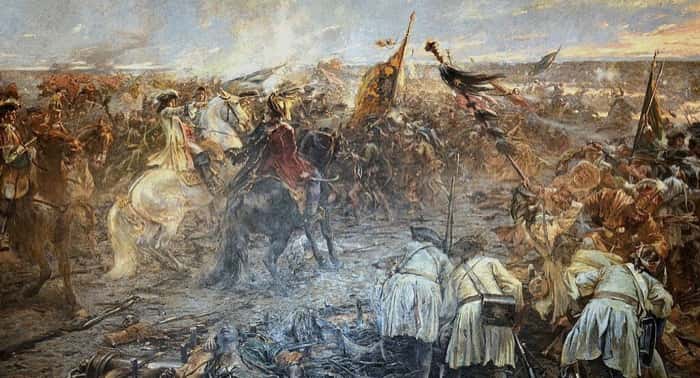
On September 11, 1697, forces of the Holy League squared off against the Ottoman Empire in what became known as the Battle of Zenta (present-day Senta, Siberia). This fierce engagement, lasting just two hours, proved to be a decisive turning point in the Great Turkish War, which had been grinding on since 1683. The Ottomans had spent years extending their grip across central Europe, but the devastating casualties and critical resource losses they suffered at Zenta brought that expansion to a halt. Ultimately, the Great Turkish War — and the Empire itself — came to an end with the signing of the Treaty of Karlowitz in 1699.
The Holy League's forces, commanded by Prince Eugene Savoy, launched their attack while Ottoman troops were in the middle of crossing the Tisza River. How did they know the timing? They had captured the leader of an Ottoman reconnaissance man and extracted crucial intelligence about the planned crossing later that day. Sultan Mustafa II, who led the Ottoman forces, was caught completely off guard, leaving his army dangerously exposed. Seizing the advantage, the Holy League arranged their troops in a crescent formation, pinning the Ottomans against the river. Artillery fire then destroyed the bridge, and the thousands of Ottoman soldiers trapped on it perished.
Sultan Mustafa II managed to escape with his life, but the Grand Vizier was not so fortunate — he perished alongside a staggering 20,000 Ottoman troops. By contrast, the Holy League suffered roughly 490 casualties. To add insult to injury, the victors captured heavy guns, the Ottoman treasury, and the state seal. These catastrophic losses left Sultan Mustafa II with little choice but to enter treaty negotiations. Under the terms of the Treaty of Karlowitz, he was compelled to surrender the territories lost at the Battle of Zenta: Hungary, Transylvania, Croatia, and Slavonia.