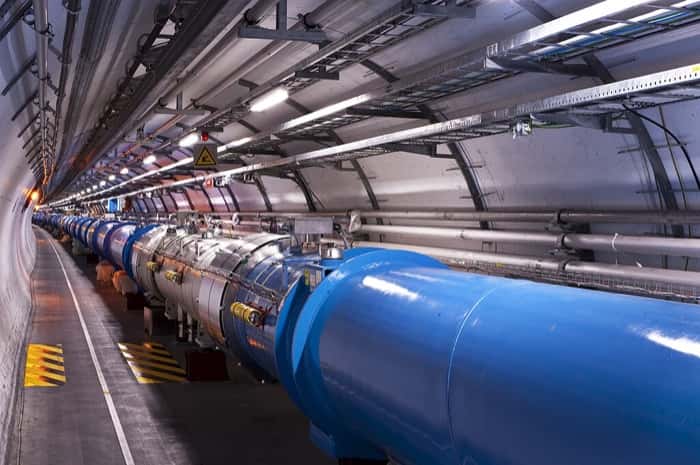
Beneath the Swiss-French border on September 10, 2008, humanity switched on the most powerful scientific instrument ever constructed. Scientists at CERN watched as the first beam of particles whipped around the Large Hadron Collider (LHC) at 10:28 a.m., a landmark moment for a 27-kilometer underground ring built to probe the universe's most profound secrets.
The World's Largest Experiment
Representing decades of planning and an investment exceeding $8 million, the LHC was an engineering marvel from the ground up. Its superconducting magnets and ultra-high vacuum systems were purpose-built to push particles to velocities approaching the speed of light, then slam them into one another—effectively recreating the conditions that prevailed in the fleeting instants after the Big Bang. With the capacity to generate up to 600 million collisions every second, nothing in the history of particle physics had ever been so audacious.
Situated at CERN's Geneva laboratory, the project stretched far beyond Europe's borders. Thousands of researchers and engineers hailing from more than 100 countries pooled their expertise in what became a truly global scientific collaboration. The moment that first proton beam completed its full loop around the ring, experimental physics entered an entirely new chapter.
Goals of the LHC
At its core, the collider was built to tackle questions that had captivated scientists for generations. Chief among them was the hunt for the Higgs boson—a particle first theorized in 1964 by Peter Higgs and François Englert—which holds the key to explaining how matter acquires mass. Beyond that, researchers set their sights on dark matter, a puzzling substance thought to make up about 25% of the universe, while also probing one of cosmology's great riddles: why matter vastly outnumbers antimatter in the cosmos.
Public Concerns and Scientific Confidence
Naturally, a machine of this magnitude drew enormous public scrutiny, and the attention wasn't universally enthusiastic. Certain skeptics worried that the high-energy collisions might spawn mini black holes or exotic strange matter capable of threatening Earth itself. Physicists roundly rejected these fears—Stephen Hawking among them—reassuring the public that any such phenomena would be entirely harmless and would disappear in an instant.
Far from triggering catastrophe, the collider's activation stood as a testament to human ingenuity and cross-border cooperation. "It's a fantastic moment," declared project leader Lyn Evans on the day the first beam circulated. "We can now look forward to a new era of understanding about the origins and evolution of the universe."
Breakthroughs and Legacy
Full operational capability would require years of meticulous testing and upgrades, yet meaningful results came sooner than many expected. CERN revealed in July 2012 that the ATLAS and CMS experiments had identified a particle matching the predicted characteristics of the Higgs boson. One year later, François Englert and Peter Higgs received the Nobel Prize in Physics, honoring the theoretical framework whose predictions the Large Hadron Collider (LHC) had triumphantly confirmed.