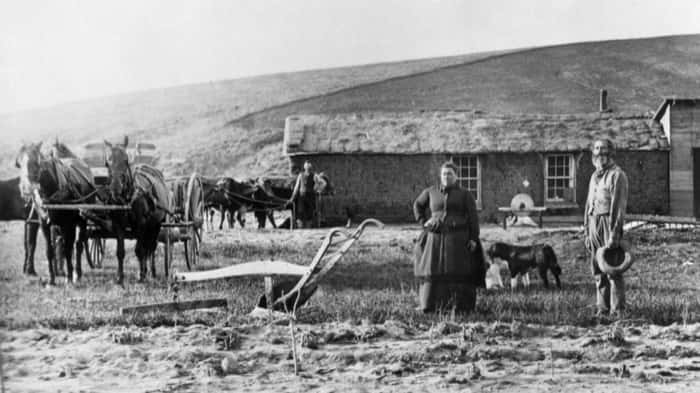
On May 20, 1862, 16th US President Abraham Lincoln put his signature on the Homestead Act — a sweeping piece of legislation that essentially handed over government land to ordinary citizens willing to meet a set of specific requirements. The driving force behind this bold move? A desire to fuel American expansion and push settlement deeper into the West.
So what did it take to stake your claim? Under the terms of the Homestead Act, any head of a family aged at least 21 could lay claim to 160 acres of government-owned western land, provided they committed to farming it for five years. During that stretch, claimants were expected to construct a house, dig a well, erect fences, and establish a working farm capable of sustaining their household. Meet all those conditions after five years, and the deed was yours. There was also a shortcut available: after six months, you could purchase the lot outright at $1.25 an acre — a reasonable figure, though still beyond reach for many.
Lincoln's landmark legislation didn't come out of nowhere. Going back to 1852, three prior efforts had been made to push similar measures through Congress. Each time, Southern lawmakers blocked them, fearing that newly settled territories would tip the balance toward free states. Once the Civil War broke out and Southern states were no longer casting votes in Congress, the path cleared, and the Homestead Act sailed through without much resistance.
There's no question the Homestead Act accelerated America's westward expansion and benefited numerous families. That said, pioneer life proved brutally demanding, and many claimants abandoned their stakes before reaching the five-year mark. Fraud was another persistent problem. Although the act was designed to help individual families, mining and logging companies routinely gamed the system by paying people to file claims on their behalf, snapping up the land to exploit the untapped resources found on or beneath it.
Over time, as available land dwindled, the amount that could be claimed was gradually reduced, and the program was slowly phased out across a lengthy period. Still, the Homestead Act wasn't officially repealed until 1976. And even then, the story wasn't quite over — the last deed issued under the Act came a few years later, once the final contract wrapped up.