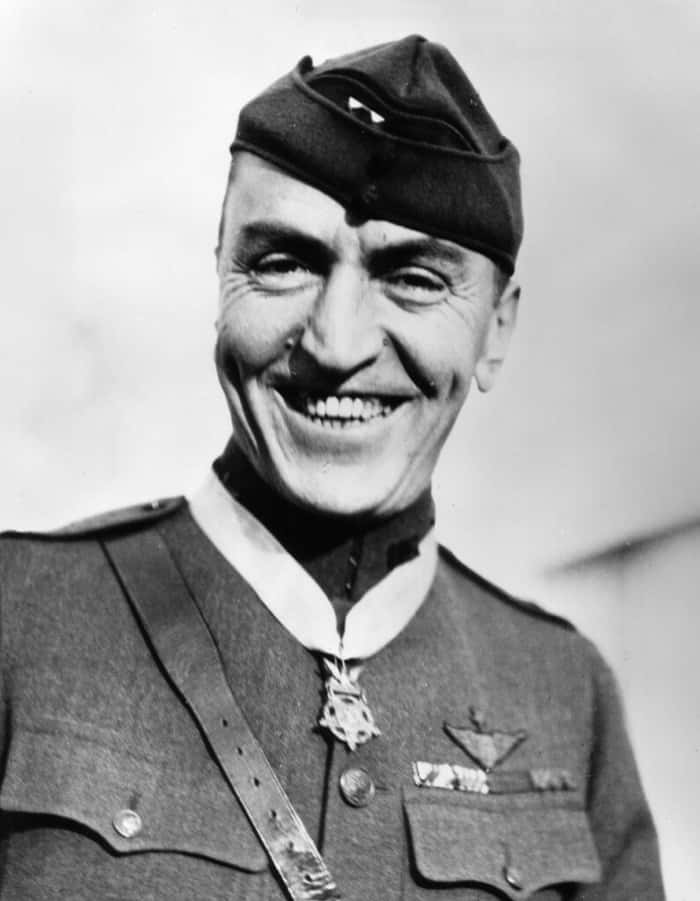
On October 8, 1890, in Columbus, Ohio, the world welcomed Eddie Rickenbacker — a man who would go on to become one of the most accomplished and highly decorated fighter pilots in the annals of American military aviation. Throughout his remarkable career, this legendary "Flying Ace" racked up 26 aerial victories and earned the prestigious Medal of Honor for his extraordinary bravery and combat skill.
Fun Facts:
- Born in Columbus, Ohio, on October 8, 1890, Eddie Rickenbacker originally carried the surname "Reichenbacher," reflecting his German heritage. When World War I brought a wave of anti-German sentiment sweeping across the country, he changed the spelling — a decision shared by countless German-Americans who anglicized their names during that era to shield themselves from widespread discrimination.
- Long before he ever climbed into a cockpit, Eddie Rickenbacker was no stranger to thrills. His career as a professional race car driver honed razor-sharp reflexes and fueled a deep passion for speed — one that many can relate to — and it was this very love of velocity that would eventually shape his daring exploits in the skies above the Western Front.
- Enlisting in the U.S. Army in 1917, Rickenbacker rose to become a flying ace over the course of World War I. His 26 aerial victories stood as the highest tally achieved by any American pilot during the conflict.
- Recognition for his extraordinary battlefield courage and leadership came in 1930, when Rickenbacker received the Medal of Honor — a testament to his exceptional bravery in combat.
- Rickenbacker's gift for leadership didn't end when the guns fell silent. His impact on the aviation industry after the war proved nothing short of transformative. Serving as president of Eastern Air Lines, he built it into a powerhouse carrier that left a lasting imprint on commercial aviation. Under his stewardship, Eastern Air Lines emerged as one of the most successful and forward-thinking airlines of its time, embracing cutting-edge technologies and blazing new routes across the map.
- Death came knocking for Eddie Rickenbacker on more than one occasion, yet he refused to answer. Among his most harrowing ordeals was a 1942 incident when his B-17 Flying Fortress crashed into the Pacific Ocean. Stranded with his crew for an agonizing 24 days — fighting off hunger, thirst, and brutal exposure to the elements — Rickenbacker's resourcefulness and steady leadership proved critical to keeping the group alive until rescue finally arrived.
- He penned Fighting the Flying Circus, a gripping firsthand account of his wartime experiences as a combat pilot.
- Eddie Rickenbacker died on July 23, 1973, at the age of 82. He left behind an enduring legacy as one of America's most revered war heroes.