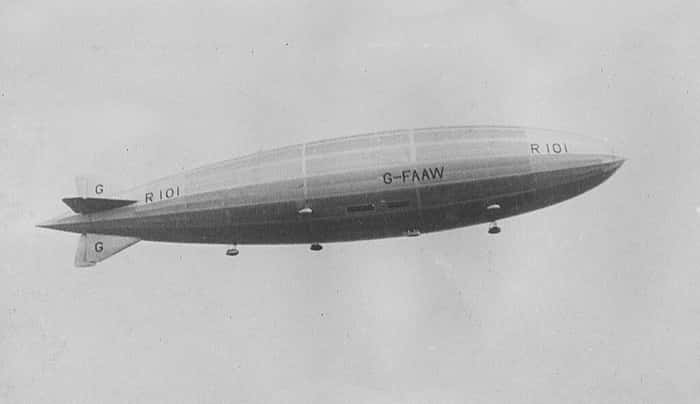
On October 5, 1930, the grand ambitions behind Britain's airship R101 came crashing down—literally and catastrophically. The enormous vessel slammed into the earth near Beauvais, France, only hours after embarking on its first international journey, claiming the lives of 48 out of 54 souls aboard. A project designed to herald a glamorous new era of air travel instead became one of aviation's starkest reminders of what happens when ambition outpaces prudence.
The Dream: Britain's Imperial Air Route
R101 was far more than a flying machine—it was a national statement. The British government envisioned it as the flagship of the Imperial Airship Scheme, an audacious plan to construct six rigid airships capable of whisking passengers on long-haul commercial routes, linking London to India and the farthest reaches of the empire by air.
Two prototypes emerged from this vision:
- R100, a more conventional craft engineered by Vickers Ltd., which successfully completed a round trip to Canada.
- R101, the government's own high-stakes creation, bristling with untested technology and constructed at the Royal Airship Works.
Where R100 played it safe, R101 swung for the fences—bigger, bolder, and far more dangerous. That difference would prove fateful.
The Warning Signs: Innovation Without Caution
R101 was a boundary-pusher that routinely defied established norms.
- It became the first rigid airship powered by diesel engines.
- Its frame relied on experimental steel, paired with novel gas valves.
- Untried materials and manufacturing methods were woven throughout its construction.
Yet each innovation brought its own headaches:
- The engines proved underpowered, excessively heavy, and prone to instability.
- Gasbags suffered persistent leaks, leaving buoyancy dangerously unreliable.
- The outer skin was fragile—tearing with alarming ease, particularly in wet conditions.
None of this was secret. Test flights had exposed serious design flaws. But political forces wouldn't wait. Key figures—among them the Secretary of State for Air Lord Thomson—demanded the vessel depart for India. Lord Thomson himself would be a passenger. Corners were cut, timelines compressed. The airship simply wasn't ready for the journey ahead.
The Crash: Over France, Into Fire
Rain was falling on the night of October 4, 1930, as R101 rose from Cardington, England. By 2 AM on October 5, the vessel found itself battling violent winds above northern France.
Over Beauvais, everything unraveled.
- Powerful gusts ripped into the nose, leaving a gasbag exposed.
- Rainfall saturated the fabric covering, dragging the bow earthward.
- The ship pitched into a steep dive, momentarily leveled off, then nosedived a second time.
When R101 met the ground, it was traveling at a mere 13.8 mph. Those who survived would later describe a deceptively gentle impact—followed by unimaginable horror. The collision wrenched a superheated engine out of alignment, triggering a hydrogen leak. Fire consumed the airship almost instantly. In those terrible moments, 48 people perished.