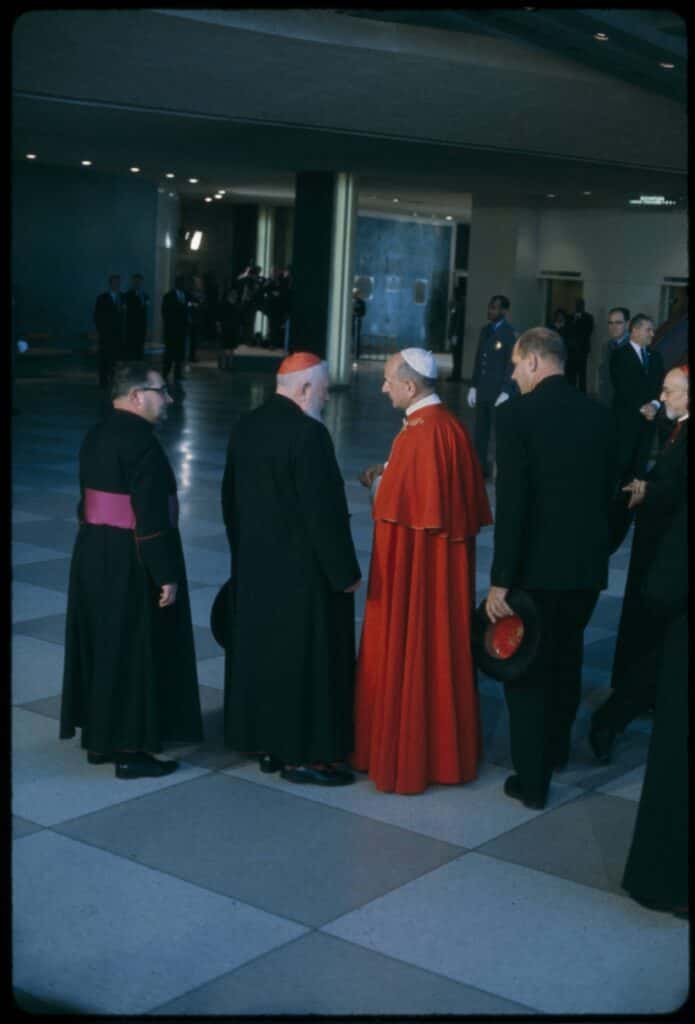
On October 4, 1965, something happened that had never occurred in the nearly 2,000-year history of the Catholic Church: a pope touched down on American soil. Pope Paul VI didn't merely visit the United States — he became the first pontiff to ever enter the Western Hemisphere. Perhaps most remarkably, the entire trip lasted a mere 14 hours.
The Purpose: A Plea for Peace
Pope Paul VI traveled with a singular purpose — not pageantry, but a direct appeal to the world's leaders. His destination: the United Nations General Assembly. The global landscape was grim. The Vietnam War was escalating. India and Pakistan were locked in conflict. The specter of nuclear catastrophe loomed large. His message cut through it all with unmistakable clarity: enough is enough.
Before 2,000 delegates, he delivered an impassioned address in French that built to a powerful crescendo: "No more war, never again war!" He made the case that weapons could never be the path to lasting peace, echoing the words of John F. Kennedy: "Mankind must put an end to war or war will put an end to mankind."
The response was immediate — every delegate rose to their feet in a standing ovation.
The Journey: A Whirlwind Through New York
Arriving at JFK Airport aboard a velvet-lined Alitalia DC-8, Pope Paul VI wasted no time setting the tone with a sweeping greeting:
"Greetings to you, America. The first pope to set foot on your land blesses you with all his heart."
What followed was a breathtaking sprint through New York City, with each stop carrying its own weight:
- St. Patrick's Cathedral: Thousands had assembled to witness his arrival, and he offered his blessing to Cardinal Francis Spellman and the faithful crowds.
- Waldorf Astoria: He sat down with President Lyndon B. Johnson in what was considered an unofficial encounter, given the absence of formal diplomatic relations between the U.S. and the Vatican at the time.
- Yankee Stadium: A crowd of 90,000 gathered as he celebrated Mass and revealed that a stone from St. Peter's Basilica would serve as the cornerstone of a new seminary in New York.
- World's Fair Pavilion: His final stop included a tour of the Vatican's exhibit, which featured Michelangelo's Pietà.
An extraordinary itinerary, all squeezed into a single day.
The Backdrop: Tight Security, Massive Crowds
The city mobilized as though preparing for a head of state — which, in many respects, it was. A staggering eighteen thousand police officers were deployed along the route, while helicopters circled above and designated protest zones were carefully monitored. A specially customized Lincoln Continental doubled as a makeshift popemobile. The price tag for overtime pay alone hit $1 million.
But the turnout justified every measure. More than a million people caught a glimpse of him in person, and an estimated 100 million additional viewers tuned in on television. The Catholic world — and far beyond it — had its eyes fixed on New York.
Legacy: The First, But Not the Last
By venturing beyond Italy's borders — something no pope had done since 1809 — Pope Paul VI shattered centuries of papal tradition. His visit to America blazed a trail for every pontiff who came after him.
In the decades since, each successive Pope has built on his example, weaving together faith and diplomacy on the world stage.