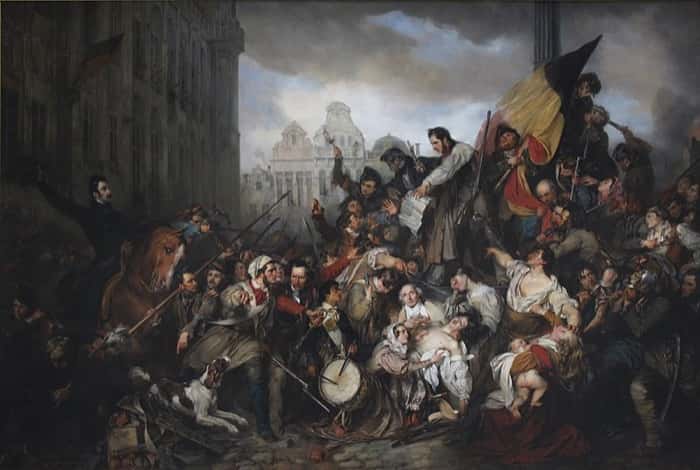
Throughout much of its existence, Belgium either belonged to larger empires or existed as a patchwork of smaller territories. Yet on October 4, 1830, everything changed — the country officially declared its independence from the Netherlands, bringing a dramatic revolution to its conclusion and giving birth to an entirely new national identity.
Fun Facts:
- On October 4, 1830, Belgium broke free from the Netherlands, a direct outcome of the Belgian Revolution.
- What kicked off the revolution in August 1830 was no single grievance but rather a tangled mix of cultural, religious, and political frustrations. The Belgian people — largely Catholic and French-speaking — found themselves fundamentally at odds with the Protestant, Dutch-speaking monarchy led by King William I. This volatile combination of linguistic, religious, and cultural divides, layered on top of deep political discontent, set the stage for open revolt.
- In standing up against King William I's Protestant and Dutch-speaking monarchy, the predominantly Catholic and French-speaking Belgian population displayed extraordinary courage and resolve.
- What started as riots in Brussels quickly spiraled into a full-scale rebellion, and by late September, revolutionaries had seized control of key cities across the region.
- The Provisional Government took the momentous step of proclaiming Belgium's independence on October 4.
- A major diplomatic milestone followed when the Treaty of London (1831) granted formal recognition to Belgium as both an independent and neutral state.
- In July 1831, Leopold I ascended to the throne as Belgium's first king, laying the foundation for a constitutional monarchy.
- The Belgian Revolution didn't happen in a vacuum — it drew powerful inspiration from the July Revolution in France in 1830, underscoring how deeply interconnected historical movements can be.
- Interestingly, Leopold I, who became Belgium's inaugural monarch, had previously been offered the Greek throne before accepting the Belgian crown.
- Had the July Revolution never taken place, Belgium would probably not have achieved its independence when it did.