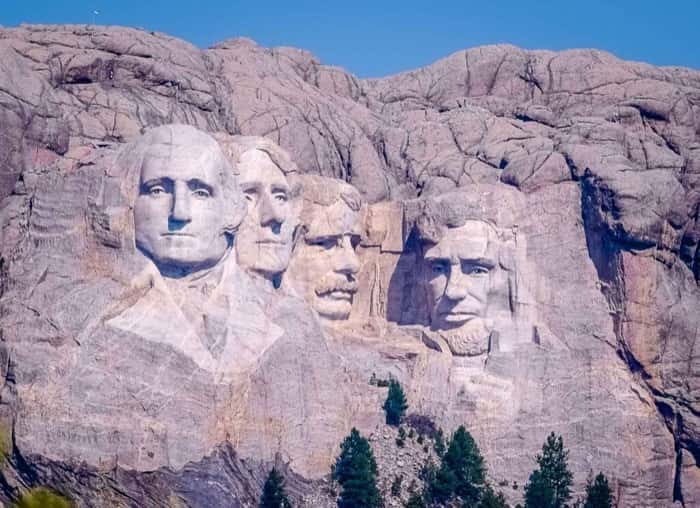
While a small painting might come together in a matter of days or weeks, the most ambitious artistic endeavors can demand years — sometimes even decades — of dedicated effort. Mount Rushmore, arguably the most iconic landmark in the United States, reached completion on October 31, 1941, following a remarkable 14 years of construction. The massive sculpture, depicting the faces of Presidents George Washington, Thomas Jefferson, Theodore Roosevelt, and Abraham Lincoln, was hewn directly into the granite of the Black Hills of South Dakota. To this day, it stands as an enduring testament to both American history and human ingenuity.
Fun Facts:
- The whole concept behind Mount Rushmore originated with Doane Robinson, a South Dakota historian who envisioned it as a way to draw tourists to the Black Hills region. To bring this bold idea to life, sculptor Gutzon Borglum was brought on board to handle both the design and supervision of the massive undertaking.
- Work got underway on October 4, 1927, and spanned a total of 14 years. The project didn't proceed without setbacks, though — it was halted on several occasions because of funding shortages, harsh weather, and the passing of Borglum himself in March 1941. Following his death, his son, Lincoln Borglum, stepped in to guide the project through its final phases.
- Four U.S. presidents are immortalized on the monument, their faces carved to a towering height of 60 feet: George Washington, Thomas Jefferson, Theodore Roosevelt, and Abraham Lincoln. They were selected based on their contributions to preserving the nation and expanding its territory, a choice that reflects the democratic values of the United States.
- Gutzon Borglum's original vision was far more ambitious — he intended to sculpt each president from head to waist. Financial constraints combined with the onset of World War II, however, meant that only the faces were ever finished.
- A workforce of more than 400 individuals contributed to carving the monument, with dynamite accounting for roughly 90% of the rock removal. Remarkably, despite the extremely dangerous working conditions, not a single fatality occurred throughout the entire construction period.
- Today, Mount Rushmore draws more than 2 million visitors each year, securing its place as one of the most frequented tourist destinations anywhere in the United States.
- For all its iconic status and tourist appeal, the monument has not been without controversy. Its placement in the Black Hills — a region held sacred by the Lakota Sioux — has fueled persistent debates surrounding its cultural impact and significance. These conversations continue to invite thoughtful and meaningful dialogue about where history, art, and culture intersect.