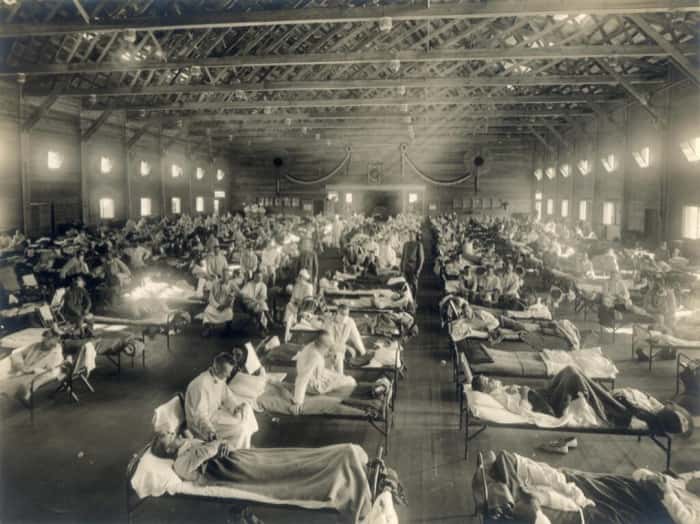
The close of the First World War in 1918 didn't bring peace to a weary world — instead, it ushered in an entirely different kind of catastrophe. Starting in March of that year, a novel influenza strain surfaced in the United States, and by April, reports of infection were pouring in from countries across the globe. What followed would become the most lethal pandemic ever recorded: the Great Influenza Epidemic, widely known as the Spanish Flu. On this day, October 31st, 1918, the pandemic reached its most devastating single-day milestone, claiming a staggering 21,000 lives.
Origin
Behind this catastrophic pandemic was a strain of Influenza A (H1N1), now believed to have originated from avian sources. With the epidemiological tools of the era being extremely limited, pinpointing exactly where the virus first emerged was simply not possible. Many people assume Spain was ground zero for the outbreak — hence the name "Spanish Flu" — but that's actually a misconception. During World War I, warring nations suppressed news coverage to protect public morale. Spain, however, was neutral in the conflict and reported openly on the deadly flu before other countries acknowledged it. That willingness to be transparent inadvertently created the false impression that the disease had started within its borders.
The Spread
A perfect storm of circumstances allowed the Spanish Flu to tear through populations at breathtaking speed. Its timing couldn't have been worse, coinciding with the final stages of World War I and dramatically worsening the crisis. Troops and ships crisscrossed the planet, carrying the virus even to remote islands. Overcrowded military camps with substandard sanitation gave the pathogen exactly the environment it needed to flourish across numerous countries. Compounding all of this, the virus was entirely new — no public health frameworks existed to combat or contain it.
Deadly Consequences
The sheer reach of the virus was staggering, infecting roughly one-third of the world's population — about 500 million people. Death estimates were equally horrifying, with fatality figures reaching as high as 100 million across the globe. Within the United States alone, approximately 700,000 people lost their lives.
What made this pandemic particularly baffling was the demographic pattern of its victims. Influenza typically poses the greatest threat to the very young and the elderly. Yet during this epidemic, the bulk of fatalities struck people between the ages of 20 and 40 — a deeply unusual and alarming trend. Without vaccines or medications capable of treating infections, communities were left with only rudimentary defenses: quarantine measures, mask-wearing, and restrictions on social gatherings.
A New Era
The immense loss of life and widespread destruction left by the pandemic became a catalyst for meaningful progress in healthcare and medical science. A renewed urgency around understanding viruses took hold, driving the development of novel vaccines and treatments over the decades that followed. Beyond the laboratory, the crisis also prompted sweeping improvements to public health infrastructure, establishing stronger systems to confront future healthcare emergencies.