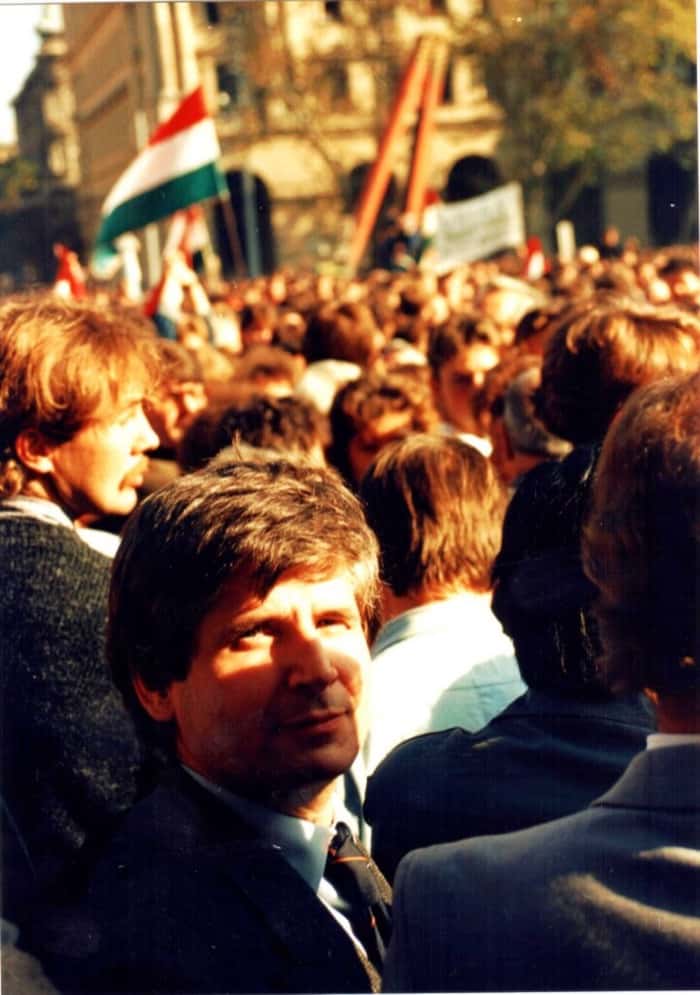
On October 23, 1989, Hungary drew the curtain on four decades of communist governance, boldly proclaiming itself a republic and stepping into a democratic future. This was no small moment — it represented a seismic shift not just within Hungary's borders but across the entire Eastern Bloc. The country had positioned itself among the very first Soviet-aligned nations to tear down the one-party communist framework that had defined its political life for so long.
The Official Declaration
Standing on the balcony of the Hungarian Parliament in Budapest, Acting President Mátyás Szűrös delivered the historic proclamation to a vast, emotionally stirred crowd gathered below.
His words rang out clearly: "I solemnly declare that as of today, October 23, 1989, Hungary is a republic and its name is the Republic of Hungary." The choice of date carried deep symbolic weight — it fell on the 33rd anniversary of the 1956 Hungarian Uprising, a pro-democracy revolt against Soviet domination that ultimately failed but left an indelible mark on the nation's conscience.
Throughout the crowd, people hoisted Hungarian flags from which the Soviet-era emblem had been deliberately cut away, echoing the unforgettable imagery of the 1956 revolution. This striking visual act served as both a forceful rejection of communist authority and a reaffirmation of Hungary's enduring aspiration for independence and democratic self-governance.
What made Hungary's transformation especially remarkable was its peacefulness. In stark contrast to the bloodshed that characterized 1956, the events of 1989 unfolded without violence. Prime Minister Miklós Németh emphasized that political courage and national unity had made this possible. "Our struggle can be fulfilled without bloodshed, not like 33 years ago," he declared during a televised address.
The Aftermath
Months of political reform had laid the groundwork for this watershed declaration. A new constitution had recently been approved by the Hungarian Parliament, clearing the path toward multi-party democracy. Free elections — the first since 1947 — were already being planned, representing a sweeping transformation of the political landscape. Opposition groups like the Hungarian Democratic Forum and the Alliance of Free Democrats had emerged, underscoring the country's decisive embrace of pluralism and open political competition.
The reverberations of Hungary's announcement extended far beyond its own borders. Its courageous stand served as a catalyst for democratic movements throughout Eastern Europe, particularly in neighboring countries such as Poland, East Germany, and Czechoslovakia. Hungary had shown that peaceful transitions away from authoritarian rule were achievable, even under the looming shadow of the Soviet Union.
In declaring its republic, Hungary did more than rewrite its own story — it helped spark the wider unraveling of communism across Europe. To this day, October 23, 1989, is celebrated as a national holiday in Hungary, honoring freedom, resilience, and the nation's long journey to reclaim its democratic identity.