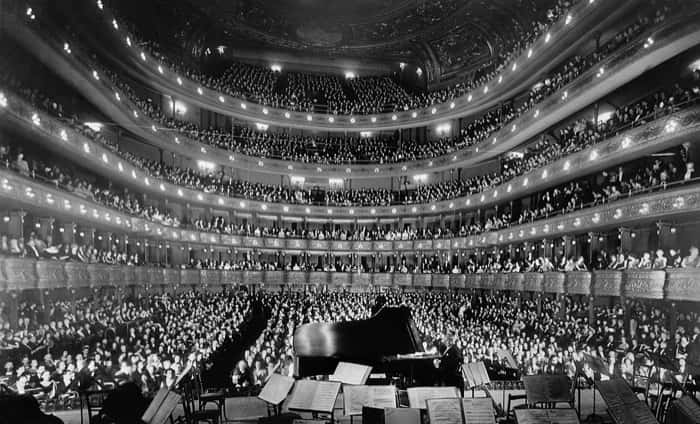
New York City's cultural landscape changed forever on October 22, 1883, when the Metropolitan Opera House threw open its doors for the very first time. Conceived as a direct challenge to the well-established Academy of Music, this stunning venue was bankrolled by powerful industrialists determined to make their mark. It didn't take long for the "Met" to evolve into an enduring emblem of artistic excellence and high-society refinement, eventually hosting some of the most legendary operatic performances the world has ever seen.
Fun Facts:
- What sparked the creation of the Metropolitan Opera House? A coalition of affluent New Yorkers — among them distinguished families like the Vanderbilts and Astors — grew increasingly annoyed at being shut out of opera events at the exclusive Academy of Music. Their solution was bold: build their own opera house, which would come to be affectionately known as "The Met."
- Situated on Broadway between 39th and 40th Streets, the original Met was an architectural gem rendered in the Renaissance Revival style. With a seating capacity of around 3,700, it ranked among the largest opera houses anywhere in the world at that time.
- For its inaugural evening, the Met staged Charles Gounod's opera Faust — a spectacular affair that drew a sold-out audience brimming with New York's social elite. That single night was enough to secure the venue's reputation as a cultural cornerstone of the city.
- Fire ravaged the original building in 1892, but the Met was rebuilt and carried on as a beacon of world-class opera. Then, in 1966, the company relocated to the new Metropolitan Opera House at Lincoln Center — a transition that reflected its ongoing expansion and deepening influence within the operatic world.
- Rising swiftly to international prominence, the Metropolitan Opera Company attracted world-renowned singers and conductors to its stage. In doing so, it was instrumental in transforming New York City into a global epicenter for opera and the performing arts — a legacy that remains a tremendous source of pride.
- Beyond the brilliance of its performances, the Met earned a reputation as a pioneer in theatrical technology. Its elaborate stage designs pushed boundaries and established new benchmarks for opera productions around the globe, leaving audiences filled with wonder and admiration.
- The Met continues to stand as one of the most prestigious opera houses on the planet. Its programming spans an impressive range — from timeless classics such as La Traviata to contemporary masterpieces like Philip Glass's Akhnaten — drawing devoted audiences from every corner of the world.