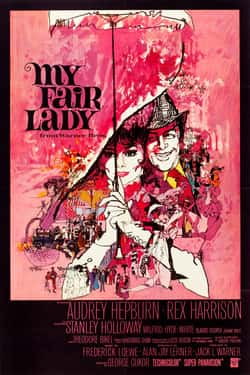
When My Fair Lady made its big-screen debut at the Criterion Theatre in New York City on October 21, 1964, audiences finally got to experience what months of buzz and record-shattering advance ticket sales had promised. The film drew its inspiration from George Bernard Shaw's 1913 play Pygmalion, which had already been reimagined as a smash-hit Broadway musical back in 1956. What followed the premiere was an outpouring of critical praise and a string of major awards, ultimately securing the film's place as one of cinema's most cherished treasures.
A Timeless Tale
At the heart of My Fair Lady lies the dynamic between two unforgettable characters: Professor Henry Higgins, a self-assured expert in phonetics, and Eliza Doolittle, a young flower seller burdened by a heavy accent. Higgins first takes notice of Eliza while she hawks flowers on the streets of London, and he presents her with an intriguing offer — speech lessons designed to help her pass as a refined society lady and open doors to better employment.
What unfolds is a story rich with themes of identity, class, discrimination, and personal growth, all woven into the evolving relationship between its two leads. As Eliza grapples with the demands and complexities of social expectations, neither she nor Higgins emerges unchanged. Remarkably, even though the source material, Pygmalion, was penned over a century ago, the issues it tackles still strike a chord with modern audiences, lending the story a timelessness that keeps it fresh and compelling to this day.
Controversial Casting
Rex Harrison stepped into the role of Henry Higgins, a part he had originated in the Broadway production of My Fair Lady, while Audrey Hepburn was cast as Eliza Doolittle. On Broadway, Harrison's co-star had been Julie Andrews, but the director opted for Hepburn instead, banking on her considerable star power to boost ticket sales.
While Hepburn may well have contributed to those record-breaking advance ticket sales, replacing Julie Andrews sparked significant backlash. Adding fuel to the controversy, Andrews went on to star in Mary Poppins the same year as My Fair Lady and took home the Academy Award for Best Actress — meanwhile, Hepburn didn't even receive a nomination for her portrayal of Eliza Doolittle.
Awards and Recognitions
Enjoying a remarkable theatrical run of 87 weeks, My Fair Lady pulled in nearly $73 million in worldwide gross. The film swept up eight Academy Awards, with honors including Best Picture, Best Director, and Best Actor for Rex Harrison. Both a massive commercial hit and a critically decorated production, the film cemented a legacy that endures to this day.