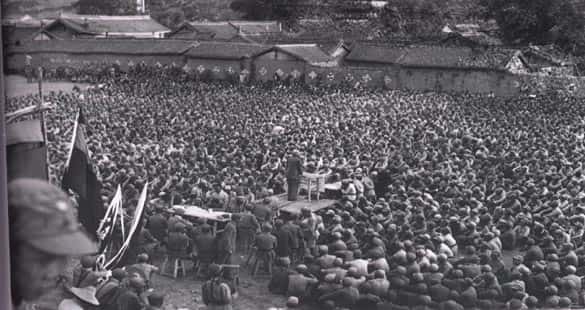
What happened on October 20, 1935? Nothing less than the culmination of one of history's most extraordinary military retreats — the Long March. Spanning a punishing year and covering 6,000 miles, this epic journey didn't just test the limits of human endurance; it fundamentally transformed the Chinese Communist Party (CCP) and elevated Mao Zedong to its helm. What started as a devastating military setback, costing the CCP enormous numbers of soldiers and vital resources, ultimately forged a powerful narrative of perseverance — one that would carry the party all the way to triumph in the Chinese Civil War.
Interesting Facts:
- Fleeing Nationalist armies under the command of Chiang Kai-shek, the CCP embarked on this massive strategic withdrawal in October 1934, finally reaching its conclusion a full year later in October 1935.
- When the march began from the Communist base in Jiangxi, more than 80,000 soldiers — each displaying remarkable courage — set off on the journey. By the time they reached Shaanxi in northern China, the brutal conditions had whittled their numbers down to a mere 8,000 to 10,000 survivors.
- The route stretched across roughly 6,000 miles of unforgiving terrain, taking the marchers over 18 mountain ranges and across 24 rivers. Among the most legendary episodes was the bold Communist victory at the Dadu River crossing.
- It was during this harrowing trek that Mao Zedong cemented his position at the top of the Communist Party. His strategic thinking, resilience, and sheer endurance earned him deep loyalty from the comrades who survived alongside him, while also crystallizing his political philosophy.
- Far from being remembered as a defeat, the Long March became an enduring emblem of Communist determination and grit. The story of their struggle against Nationalist forces resonated deeply with the Chinese people, winning the CCP considerable popular support.
- Many historians regard the Long March as the critical turning point that guaranteed the CCP's survival as a political and military force, ultimately paving the road to their Chinese Civil War victory in 1949.
- In modern China, the Long March holds a place of deep reverence. It stands as a foundational chapter in the Communist Party's origin story — a symbol of revolutionary strength and unyielding resolve.
By surviving the Long March's conclusion on October 20, 1935, the CCP did more than simply endure — they laid the groundwork for their eventual ascent to power in China, creating one of the most consequential turning points in modern history.