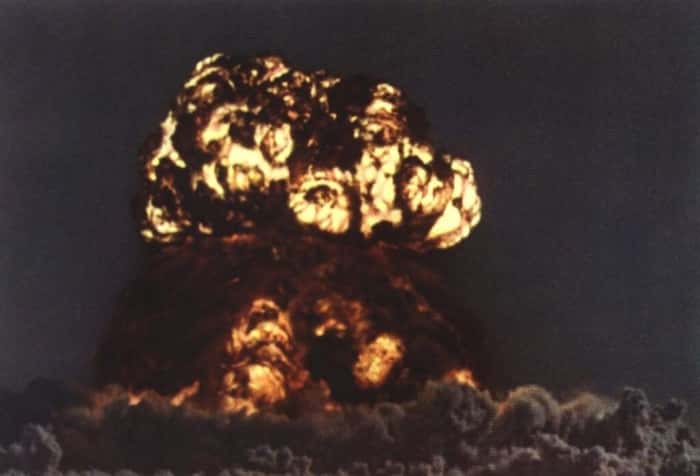
When most people think about the Cold War, they picture a two-way arms race between the United States and the Soviet Union. But the reality was far more complex — several other nations pursued nuclear capabilities during this era as well. On October 17, 1964, China successfully carried out its inaugural atomic bomb test under the codename Project 596, joining an exclusive club as the fifth country to officially possess nuclear weapons.
Sino-Soviet Split
The driving force behind China's aggressive push toward military development was a dramatic falling-out between the People's Republic of China and the Soviet Union during the 1950s — an event known as the Sino-Soviet Split. This rupture shattered the unity of the communist bloc. At its heart was Soviet leader Nikita Khrushchev's public condemnation of the legacy and leadership of his predecessor, Joseph Stalin. For Chinese leader Mao Zedong, who had closely modeled his own governing approach on Stalin's example, the denunciation felt deeply personal. He came to regard Khrushchev as someone who had betrayed the very foundations of communist ideology.
Over the span of a decade, relations between the two nations grew increasingly bitter and petty. Zedong did not hold back in his public criticism of the Soviet approach, prompting the Soviet Union to refuse sharing its nuclear bomb model with China. Determined not to be left behind, China threw itself into building its own nuclear arsenal — a move that pushed the two powers dangerously close to open conflict.
Project 596
The codename Project 596 was deliberately chosen to mark June 1959, the specific month and year when the Soviet Union pulled its support, effectively making China's nuclear ambitions a matter of public record.
A little more than six years after formally launching its nuclear program, China detonated its first atomic bomb. The test took place on October 17, 1964, at the Lop Nur test site, situated in a remote and barren stretch of northwest China. The device, which bore the nickname 596, produced a yield of 22 kilotons, and the test was declared a success.
Significance
By successfully testing an atomic bomb, China became the fifth nation in the world with nuclear weapons — a development that profoundly altered the landscape of global politics.
Though the growing number of nuclear-armed countries might understandably raise alarm, China moved quickly to issue a reassuring declaration: it has no intention of being the first to use a nuclear weapon against any country, at any time or under any circumstances.