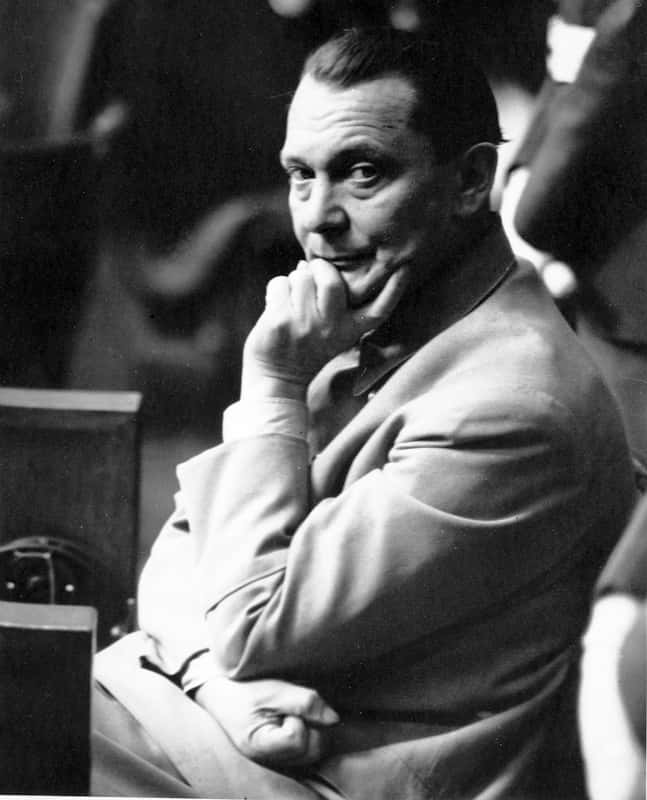
When World War II came to a close, the Nuremberg Trials became the stage where prominent Nazi leaders were held accountable for their horrific actions. Hermann Göring, among Adolf Hitler's most trusted and powerful lieutenants, cheated the executioner on October 15, 1946, taking his own life mere hours before he was set to hang. Having been found guilty of war crimes and crimes against humanity, Göring swallowed a cyanide pill — a defiant and deeply controversial final act that stunned the world and robbed the tribunal of its most high-profile execution.
Interesting Facts:
- Within the hierarchy of Nazi Germany, Hermann Göring held enormous power. He commanded the Luftwaffe (German Air Force) and stood as one of Adolf Hitler's closest associates, playing a pivotal part in both the Holocaust and the ruthless expansion of Nazi dominance.
- Following the conclusion of World War II, Allied forces captured Göring, making him the most senior Nazi leader to face the Nuremberg Trials. There, he answered charges of war crimes, including his direct involvement in the systematic genocide of millions.
- Though the tribunal handed down a sentence of death by hanging, Göring never reached the gallows. On the night of October 15, 1946 — the eve of his scheduled execution — he took his own life by swallowing a cyanide pill that had been smuggled into his prison cell.
- How exactly Göring managed to get his hands on the poison remains a source of enduring controversy, given the supposedly tight security protocols enforced at the Nuremberg prison.
- Authorities at Nuremberg were left deeply frustrated by his death, as it stripped them of the chance to carry out justice against one of the Nazi regime's most infamous war criminals.
- Even though Göring evaded execution, his legacy is forever bound to the horrors of the Nazi era — most notably the Final Solution, which claimed the lives of millions of Jews and other persecuted groups throughout the Holocaust.
- In the years that followed, Göring's suicide emerged as one of the most widely discussed episodes of the post-war era, coming to represent the complicated and often haunting legacy left behind by the Nuremberg Trials.