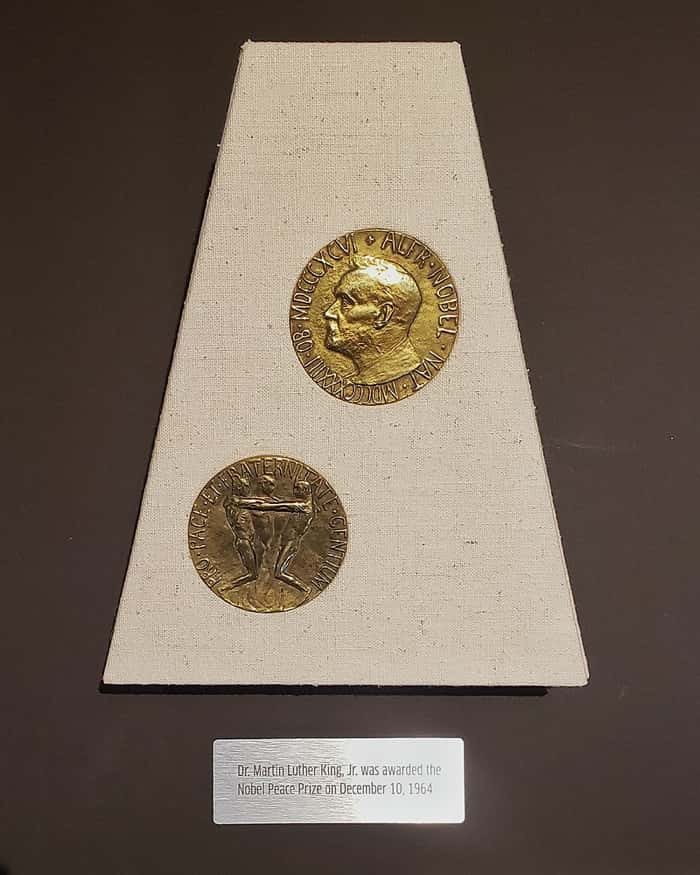
It's hard to think of a figure whose impact on history runs as deep as that of Dr. Martin Luther King Jr. When the Nobel Peace Prize was bestowed upon Dr. King on October 14, 1964, it recognized his steadfast dedication to achieving racial equality in America through nonviolent means. His pivotal role in the civil rights movement didn't just reshape the United States — it galvanized people across the globe to pursue justice through peaceful action.
Fun Facts:
- On October 14, 1964, Martin Luther King Jr. received the Nobel Peace Prize in honor of his advocacy for equality and justice through nonviolent resistance as a leader of the American civil rights movement.
- Remarkably, Dr. King was only 35 years old when he received the honor, making him the youngest Nobel Peace Prize laureate at the time — a powerful testament to his relentless work against racial segregation and injustice.
- Among the achievements the Nobel Committee specifically recognized were Dr. King's instrumental role in the Montgomery Bus Boycott and his leadership during the 1963 March on Washington, the occasion of his legendary "I Have a Dream" speech.
- In a characteristically selfless gesture, Dr. King committed the entire $54,000 in prize money to advancing the civil rights movement, choosing not to keep any of the award for personal use. That level of devotion to the cause remains deeply inspiring.
- Deeply influenced by Mahatma Gandhi, Dr. King viewed nonviolence not merely as an abstract philosophy but as a potent instrument of transformation. Through peaceful protests, marches, and speeches, he showed the world just how powerful peaceful resistance could be.
- Beyond cementing his global standing as a human rights champion, Dr. King's Nobel Prize fueled civil rights movements far beyond American borders — from South Africa to Northern Ireland. His vision united people across nations in a shared pursuit of justice.
- Dr. Martin Luther King Jr. never stopped championing peace and justice right up until his assassination in 1968. His Nobel Peace Prize stands as a powerful symbol of his unyielding commitment, and it endures as one of the defining moments in a life devoted entirely to service. His legacy and the mark he left on the world continue to be honored.