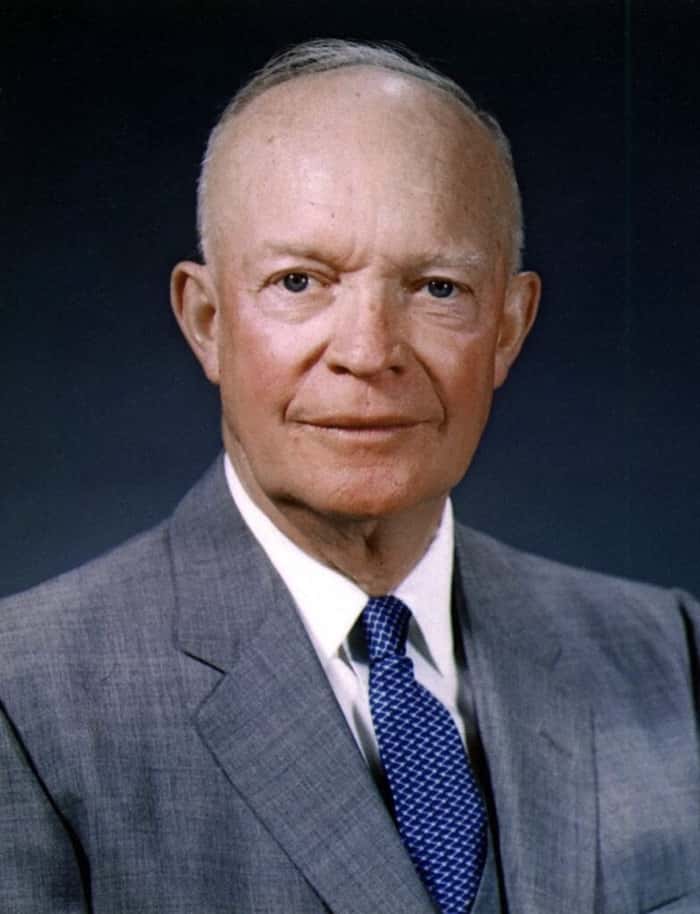
Dwight D. Eisenhower came into the world on October 14, 1890, in Denison, Texas. His impact on the American story remains nothing short of extraordinary — from steering Allied forces toward triumph in World War II to leading the nation through two terms as the 34th President of the United States.
Fun Facts:
- Dwight David Eisenhower arrived on October 14, 1890, in the vibrant town of Denison, Texas, as the third of seven sons in his family. He would spend his formative years growing up in the heartland of America, in Abilene, Kansas.
- It was during the chaotic upheaval of World War II that Eisenhower's star rose at a breathtaking pace. His remarkable strategic mind — the defining hallmark of his career — propelled him to the role of Supreme Commander of the Allied Expeditionary Forces in Europe. In that capacity, he masterminded the legendary D-Day invasion of Normandy in 1944.
- The postwar years saw Eisenhower's popularity reach extraordinary heights, and he went on to serve as President of Columbia University before making his leap into the political arena.
- Winning the presidency in 1952, Eisenhower became the 34th President of the United States and held office for two terms spanning 1953 to 1961. Among the hallmarks of his administration were the launch of the Interstate Highway System, championing the space race, and bringing the Korean War to a close.
- The Eisenhower Doctrine stands out as one of his most notable accomplishments — a policy designed to curb the spread of communism in the Middle East.
- A calm demeanor that offered reassurance during turbulent times defined Eisenhower's time in the White House, along with his unwavering leadership. He deftly navigated the high-wire tensions of the Cold War while simultaneously fostering economic growth and driving the expansion of the nation's infrastructure, ultimately leaving behind a legacy rooted in progress and stability.
- On March 28, 1969, Dwight D. Eisenhower died, but his profound and enduring legacy as both a military hero and a statesman lives on, continuing to shape the course of American history.