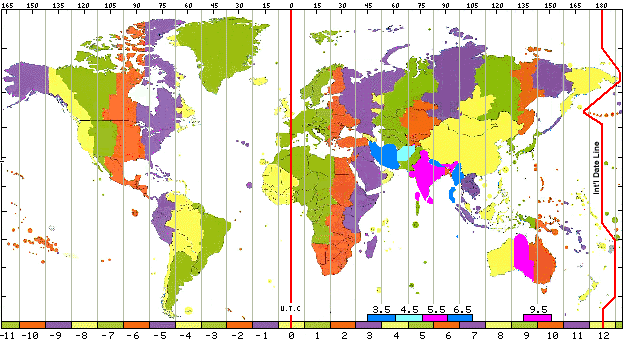
On October 13, 1884, history took a remarkable turn when delegates representing 26 nations gathered in Washington, D.C. to tackle a problem that had frustrated international affairs for far too long—the absence of any unified system for measuring time. What emerged from this gathering would reshape how the entire world kept track of the clock: Greenwich Mean Time (GMT) was established as the universal time standard, anchored by a prime meridian running through Greenwich, England.
Fun Facts:
- Held on October 13, 1884, the International Meridian Conference stands as a defining milestone in the story of both navigation and timekeeping. Delegates from 26 nations came together and designated Greenwich, England as the site of the prime meridian, effectively turning it into the world's reference point for universal time. This agreement marked a decisive leap toward harmonizing how the globe measured hours and minutes.
- Running right through the Royal Observatory in Greenwich, the prime meridian sits at 0° longitude. Founded in 1675, this observatory earned its central role in time calculation thanks to the precision and dependability of its measurements. Every time zone on the planet is reckoned from this single point, cementing its place as the foundation of standardized global time.
- Prior to the conference, no shared standard for tracking time existed anywhere in the world. Cities and countries each relied on their own local time, frequently derived from the sun's position overhead. The result was widespread confusion, particularly when it came to commerce and travel.
- For seafaring nations especially, the establishment of Greenwich Mean Time (GMT) proved transformative. With the prime meridian now serving as a fixed reference, the process of calculating longitude was fundamentally revolutionized, opening the door to navigation that was both more precise and more efficient.
- Representatives from twenty-six countries were present at the conference, among them the United States, France, and Japan. Of all those in attendance, only San Domingo (now the Dominican Republic) cast a vote opposing the proposal.
- In the modern era, Coordinated Universal Time (UTC) has stepped in to replace GMT as the prevailing global time standard. Even so, GMT continues to serve as the backbone for time zone calculations, especially within the aviation and maritime industries.
- Beyond clocks and compasses, the move toward a universal time standard brought order to railway timetables and fueled the expansion of international trade and communication. Synchronizing activities across borders became dramatically simpler as a result.