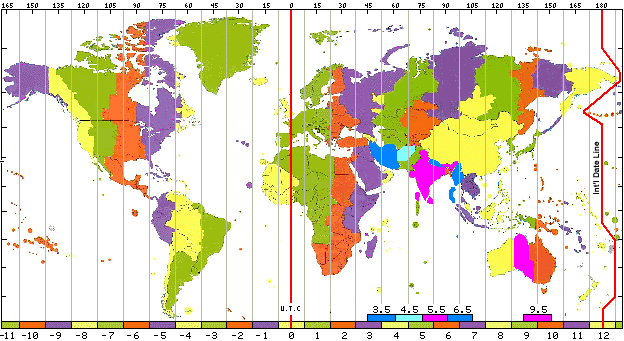
It's hard to imagine a time when the world couldn't agree on what time it was — but that's exactly the problem that came to a head on October 13, 1884. In Washington, D.C., forty-one delegates representing twenty-five nations convened for the International Meridian Conference, an event that would fundamentally reshape how humanity keeps track of time.
Their decision? To officially designate the Greenwich Meridian in England as the Prime Meridian — the zero point for global longitude and the anchor for Universal Time.
A World Out of Sync
Prior to 1884, telling time was an entirely local endeavor. Each city relied on the position of the sun to set its clocks, a practice that bred confusion across borders and wreaked havoc on railroad schedules and maritime shipping.
- The U.S. alone had over 100 different local times.
- Railway stations ran on their own clocks.
- Navigators used dozens of prime meridians, from Paris to Rome to Washington.
The result was a fragmented patchwork that made international trade, travel, and communication needlessly difficult and unreliable.
The Road to Reform
Pressure for a unified timekeeping standard had been building throughout the mid-19th century, driven by astronomers, scientists, and especially the railroad industry. Sandford Fleming, a Canadian engineer and passionate advocate for reform, put forward a bold plan: carve the globe into 24 time zones, each tethered to one shared Prime Meridian. The concept gained serious momentum by the early 1880s, and President Chester A. Arthur seized the moment, convening the conference in Washington, D.C., with a clear mission — to settle on a single reference meridian for both navigation and timekeeping.
Why Greenwich?
Britain held a significant advantage going into the debate. The Royal Observatory in Greenwich, bolstered by Britain's dominance in maritime navigation, had already made the Greenwich Meridian the standard on over two-thirds of the world's nautical charts by 1884. This wasn't merely a matter of prestige — it was pure pragmatism. Greenwich boasted decades of meticulous astronomical observations and had already become the de facto global reference point. The conference vote didn't create a new standard so much as formalize one that already existed.
The Conference and the Vote
When delegates cast their ballots on October 13, 1884, the result was decisive:
- 22 nations voted in favor of Greenwich.
- 1 (San Domingo) voted against.
- France and Brazil abstained.
France, reluctant to cede symbolic ground to its cross-Channel rival, dragged its feet before finally adopting the system in 1911. Even then, French authorities stubbornly referred to Greenwich time as "Paris mean time, retarded by 9 minutes and 21 seconds" for years — a gloriously petty act of linguistic resistance.
What Changed?
The resolutions that emerged from the conference laid out several key principles:
- Greenwich as the Prime Meridian (0° longitude).
- Universal time is to be counted from Greenwich.
- A 24-hour day beginning at midnight in Greenwich.
- A hope (not a rule) that time zones and the nautical/astronomical days would align with the new system.
Notably, the conference stopped short of formally creating time zones — but it planted the seeds. North American railroads moved to standardized time based on the Greenwich system within a year, and other nations gradually fell in line.