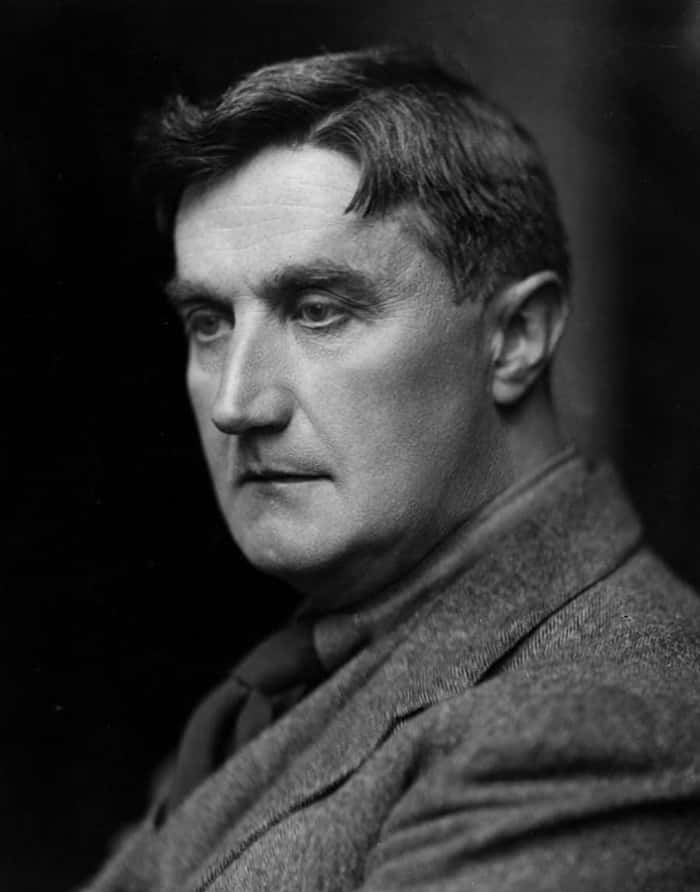
On October 12, 1872, in the sleepy village of Down Ampney in Gloucestershire, England, a child was born who would go on to reshape the landscape of English classical music. From those humble beginnings in a small Cotswold parish, Ralph Vaughan Williams would build a towering legacy that came to define the sound of a nation throughout the 20th century.
His impact reached far beyond the concert hall—it wove itself into the very fabric of English cultural identity.
A Scholar with Sound in His Blood
Vaughan Williams entered the world as part of a deeply distinguished intellectual lineage, with family connections to both the Darwin and Wedgwood families. Growing up amid such tradition and cerebral energy gave him a remarkably rich cultural upbringing. When his father died while he was still young, the family moved to Leith Hill Place in Surrey, a home where music quickly became a central thread of daily life.
His formal education took him through Charterhouse School, the Royal College of Music, and Trinity College, Cambridge. Along the way, he studied under an extraordinary roster of mentors: Charles Stanford and Hubert Parry in London, then Max Bruch in Berlin, and finally Maurice Ravel in Paris. This remarkable training steeped him in the worlds of German Romanticism and French Impressionism alike—yet through it all, his distinctly English sensibility remained firmly intact.
Collecting the Sounds of the Countryside
Around the turn of the century, Vaughan Williams embarked on something remarkably unusual for a composer of his stature: he ventured into the English countryside to gather and preserve folk songs and carols directly from the people who sang them. In his view, the music of everyday people held within it the very soul of a nation.
His role as editor of The English Hymnal allowed him to transform sacred music for Anglican worship. Among his hymn tunes, two stand out as enduring treasures still heard in churches today—Sine Nomine ("For All the Saints") and Down Ampney ("Come Down, O Love Divine").
War, Loss, and a New Voice
When World War I erupted, Vaughan Williams was already in his 40s, yet he insisted on volunteering for duty. He went so far as to lie about his age in order to enlist, eventually serving as a stretcher-bearer in France before rising to become an officer in the Royal Garrison Artillery. The horrors he witnessed and the friends he lost—among them the composer George Butterworth—scarred him deeply and left an indelible mark on his creative voice.
The music that followed the war took on a more introspective, haunting quality. Pieces such as the Pastoral Symphony and Dona Nobis Pacem reverberate with the ghostly echoes of those battlefields.
A Composer for All Seasons
Across a remarkably long and prolific career, Vaughan Williams explored virtually every musical genre imaginable: nine symphonies, five operas, chamber music, ballet, film scores, and sweeping choral works. He also gave Britain some of its most cherished orchestral compositions, including:
- The Lark Ascending
- Fantasia on a Theme by Thomas Tallis
- English Folk Song Suite
- Five Variants of Dives and Lazarus
What makes his music so distinctive is the way it fuses tradition with innovation—grounded and earthy one moment, transcendent the next, yet always unmistakably modern and thoroughly English.
Legacy of a Modern Master
Though he turned down a knighthood, Vaughan Williams did accept the Order of Merit in 1935. His creative vitality never waned, and he continued composing well into his 80s. Following the death of his first wife, he married the poet Ursula Wood.
His life came to a close on August 26, 1958. Today, his ashes lie in Westminster Abbey, resting near those of Henry Purcell—two towering figures of English music united across the centuries.