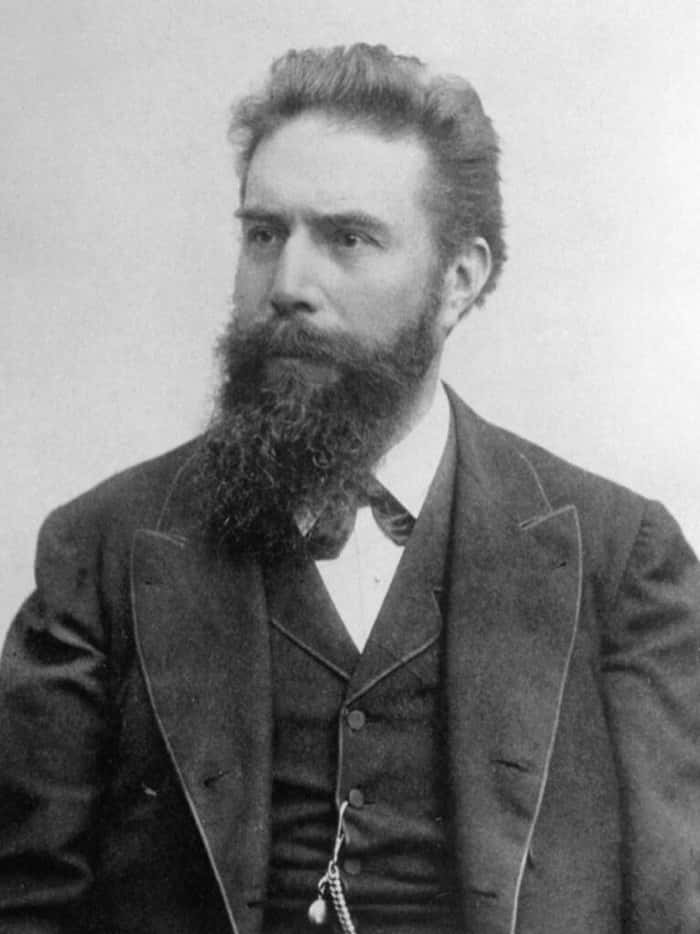
A chance encounter with the unknown would forever reshape the world of medical science. While experimenting with cathode rays in his home laboratory on November 8, 1895, German physicist Wilhelm Röntgen spotted a fluorescent glow emanating from across the room — an unexpected observation that would ultimately lead him to discover X-rays.
Early Life and Career
Born in 1845 in Lennap, Prussia, Wilhelm Röntgen relocated to the Netherlands at just three years old. Though he would go on to demonstrate remarkable scientific talent, his early academic life was anything but smooth. A prank led to his expulsion from elementary school — an accusation he insisted throughout his life was entirely false.
Without a high school diploma in hand, Röntgen found the road to higher education riddled with obstacles. Multiple institutions turned him away before he successfully passed the entrance exam for the Zurich Polytechnic in Switzerland in 1865. He pursued mechanical engineering there and completed his Ph.D. in 1869. His academic career then took him through teaching positions at several universities, eventually rising to hold the Chair of Physics at both the University of Würzburg and the University of Munich.
The Discovery
It was during his tenure at the University of Würzburg that Wilhelm Röntgen devoted many late evenings to research in his laboratory. On the night of November 8, 1895, he was absorbed in work with a cathode ray tube — a vacuum tube designed to project images onto a phosphorescent screen. What caught him off guard was that a fluorescent screen positioned across the room had begun to glow, despite being shielded by the cathode ray tube. Intrigued by this puzzling phenomenon, he dove deeper into investigation. What followed was an accidental breakthrough that would come to be known as X-rays — a revolutionary leap forward for both science and medicine.
In the weeks that followed his initial observation, Röntgen threw himself into rigorous experimentation and careful documentation. Before presenting his findings to the wider world, he captured the first medical X-ray — an image of his wife's hand — as a dramatic demonstration of what this new technology could reveal.
Legacy
Rather than patent his discovery, Röntgen chose to share it freely with the scientific community — a decision that proved pivotal. Physicians could now peer inside the human body without resorting to surgery, and this capability transformed medical practices with remarkable speed.
Recognition followed in 1901, when Röntgen received the inaugural Nobel Prize in Physics for his groundbreaking work. His lasting influence is celebrated every year on November 8th, now observed as International Day of Radiology — a tribute to the profound impact his discovery continues to have on the medical community.