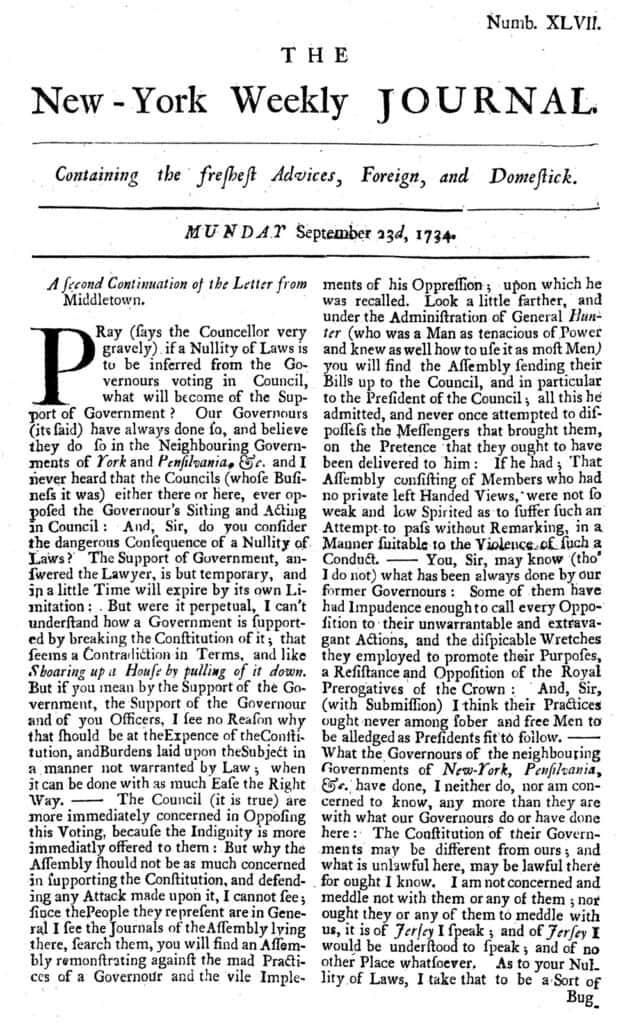
Let's turn the clock back to a pivotal moment in the story of American journalism. On November 5, 1733, a brand-new publication hit the streets: The New York Weekly Journal. Its founder, printer John Peter Zenger, likely had no idea just how consequential his venture would become. The paper rose to prominence as a bold defender of press freedom in the American colonies. Zenger's willingness to openly challenge the colonial government landed him behind bars, yet his acquittal would go on to establish a groundbreaking precedent for free speech and an independent press in America.
Fun Facts:
- John Peter Zenger, a German-American printer, launched The New York Weekly Journal with audacious determination, wielding it as a weapon to expose and criticize the corrupt behavior of William Cosby, New York's colonial governor.
- It didn't take long for the journal to earn a reputation as a relentless critic of governmental misconduct, running articles that openly challenged and scrutinized Cosby's decisions and policies.
- Zenger found himself arrested and slapped with libel charges in 1734 over his pointed articles. His defense lawyer, Andrew Hamilton, mounted a revolutionary argument: that truth itself should serve as a valid defense against accusations of libel — a concept destined to leave a deep imprint on American legal tradition.
- The trial concluded with a not-guilty verdict for Zenger, representing a landmark triumph for press freedom. It cemented the powerful principle that journalists could hold government officials accountable through criticism, provided their statements were grounded in truth.
- Frequently referenced as a forerunner to the First Amendment, this landmark case helped build the groundwork for one of the most vital components of the U.S. Constitution. The First Amendment enshrines both freedom of speech and freedom of the press — principles that were championed during Zenger's trial and that remain central to the American media landscape today.
- The New York Weekly Journal kept its presses running until 1751, persisting in its mission to question authority and advance the cause of a free and independent American press. The precedent born from Zenger's trial and acquittal empowered the press to scrutinize those in power, opening the door to the vigorous and autonomous media tradition that defines the United States.
- Today, the legacy of Zenger and The New York Weekly Journal stands as a defining milestone in the ongoing struggle for journalistic liberty and press rights within democratic societies. Their fearless defiance of government censorship remains a source of inspiration for journalists and press freedom advocates across the globe.