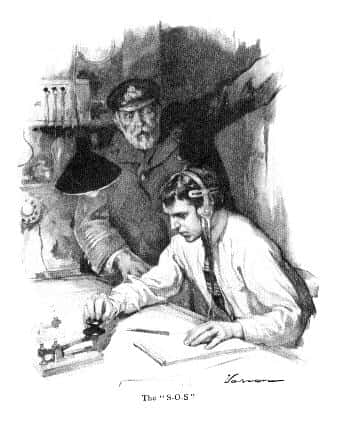
On November 3, 1906, delegates at the International Radiotelegraph Conference in Berlin reached a decision that would forever reshape how the world calls for help. By establishing "SOS" — transmitted as "· · · – – – · · ·" — as the universal distress signal, they gave ships and emergency responders a shared language of urgency, cutting through confusion with remarkable clarity. It was a pivotal moment in the history of emergency communication, and to this day, few signals are as instantly recognizable across the globe. So what exactly makes this decision so significant? Let's break it down.
Fun Facts:
- Simple and Clear: What makes the "SOS" pattern so effective is its sheer simplicity. Three dots, three dashes, three dots — it's fast to transmit, easy to pick up, and nearly impossible to confuse with anything else, even under the most difficult conditions.
- Why "SOS"? Here's a common misconception worth clearing up: "SOS" doesn't actually stand for any particular phrase. It earned its place as the standard distress call purely because its Morse code pattern was distinct and effortless to send. That said, people have long attached meanings to the letters, with "Save Our Souls" and "Save Our Ship" being the most popular interpretations.
- Immediate Impact: This wasn't just a historic milestone — it was an urgently needed one. Almost immediately after its adoption, ships and rescue teams around the world embraced the signal as a critical life-saving tool. Its importance was dramatically demonstrated during the Titanic disaster in 1912.
- Lasting Legacy: Even in an era dominated by digital communications and GPS technology, the SOS signal has never lost its relevance. Its enduring significance is hard to overstate — it remains a globally recognized call for help in certain emergencies, and there's every reason to believe it will continue serving that role for many decades to come.