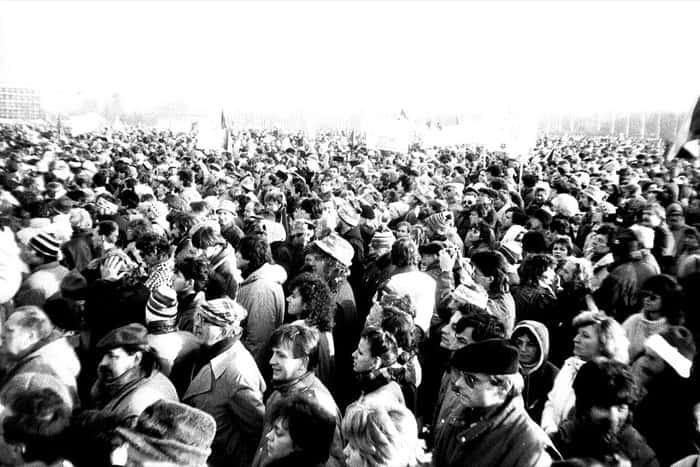
When the Communist government in Czechoslovakia surrendered its grip on power on November 29, 1989, it marked the culmination of a breathtaking series of events known as the Velvet Revolution. It all started with a student-led protest on November 17 that rapidly snowballed into a nationwide movement demanding democratic reforms and the dismantling of Communist rule. In just a matter of weeks, the mounting pressure proved irresistible. The country's transition to democracy unfolded without bloodshed, cementing the Velvet Revolution's reputation as one of modern history's most remarkable examples of non-violent uprising.
Fun Facts:
- The Velvet Revolution- Its name reflects the strikingly peaceful character of the movement, which kicked off on November 17, 1989, when brave students took to the streets of Prague in protest. Fueled by deep frustration with Communist governance and a hunger for political liberty, these young people ignited a revolution that would alter the trajectory of their nation forever.
- A Wave of Protests- What began as a student demonstration rapidly mushroomed into something far larger, as thousands of people descended on Prague's Wenceslas Square for daily protests. People from every background and profession stood shoulder to shoulder, demanding change and freedom — a powerful testament to what collective action can accomplish.
- Government Concession- Confronted with overwhelming public opposition and mounting international pressure, the Communist government ultimately chose to let go of its monopoly on power. The Federal Assembly took the formal step of striking out the constitutional clause that had guaranteed the Communist Party's dominance on November 29, opening the door to sweeping democratic reforms.
- Vaclav Havel's Role- Long a thorn in the side of the Communist regime, dissident playwright Vaclav Havel rose to prominence as one of the revolution's central figures. His election as President within a month of the revolution's climax became a potent symbol of Czechoslovakia's embrace of democracy.
- A Peaceful Transition- What set the Velvet Revolution apart from so many other uprisings was its largely non-violent character, showcasing the extraordinary effectiveness of peaceful resistance. This approach served as a beacon of hope for other Eastern European nations, proving that transformative change didn't have to come at the cost of bloodshed.
- Legacy of Change- The collapse of Communism in Czechoslovakia represented a pivotal moment for the country, eventually setting the stage for Czechoslovakia's peaceful split into the Czech Republic and Slovakia in 1993. To this day, the Velvet Revolution endures as an iconic symbol of non-violent resistance.