Rewritten Article
In 1922, history witnessed a golden revelation. Howard Carter, a British archaeologist, together with Lord Carnarvon, his patron, stepped into Tutankhamun's tomb—a space sealed for more than 3,000 years. They were the first to breach the burial chamber of this young pharaoh from Egypt's 18th Dynasty in over three millennia. The discovery would captivate global attention and spark an enduring obsession with ancient Egypt that continues a century later.
All About Tut
"King Tut," as Tutankhamun became universally known, was merely 18 when death claimed him. His reign lasted under a decade during the 14th century B.C., leaving minimal historical impact—until Carter's breakthrough changed everything. Political and religious upheaval had erased his name from monuments, causing Tutankhamun to fade into obscurity. The whereabouts of his burial site had been forgotten entirely. Yet Carter persisted against all odds. While experts insisted every tomb in the Valley of the Kings had already been discovered, Carter held firm to his conviction that Tutankhamun's resting place awaited discovery.
With Carnarvon's financial backing, he searched the desert for years. On November 4, 1922, his workers discovered a solitary step leading to a door that had been sealed. November 23 brought them past the initial barrier after three weeks of anticipation. Beyond it stretched a cramped corridor. Another door waited at its terminus. Carter then pierced the second seal on November 26, lifting a candle to glimpse what lay within. Lord Carnarvon, standing behind him, inquired, "Can you see anything?" Carter responded: "Yes, wonderful things." Wonderful things indeed awaited them.
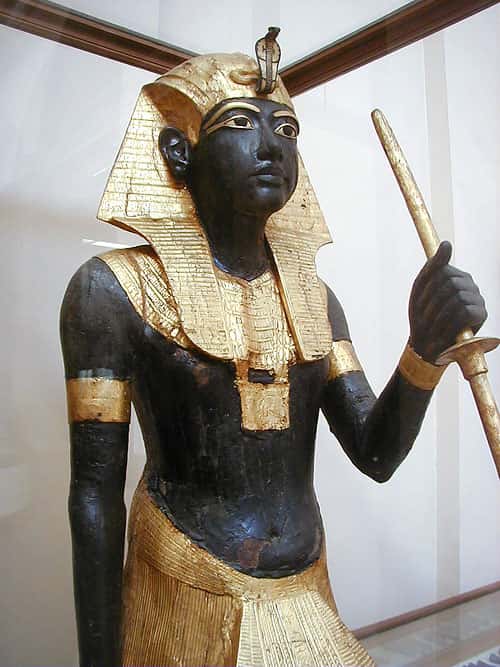
The candle's wavering light illuminated an antechamber crammed with treasures: statues, golden shrines, chariots, furniture, and countless other objects.
What Happened Next
Over subsequent years, Carter's team methodically cleared the tomb's four chambers. More than 5,000 artifacts filled the space, with many remarkably well-preserved. The collection included possessions Tutankhamun had used during his lifetime—weapons, clothing, jewelry—alongside items created specifically for his journey to the afterlife. Yet everything paled beside the contents of the burial chamber itself: within a stone sarcophagus sat three coffins, one nested inside another. The final coffin, fashioned from solid gold throughout, contained the boy-king's mummified body. The find ranked among archaeology's most momentous discoveries ever. These treasures provided an unparalleled window into ancient Egyptian royal existence. The magnificence, artistic mastery, and symbolic depth captured worldwide fascination. A phenomenon called "Tutmania" swept across continents.
Carter's reputation transformed from dismissed outsider to celebrated figure. The discovery revolutionized Egyptology while establishing fresh benchmarks for archaeological excavation and artifact conservation. Today, the Egyptian Museum in Cairo houses most of these treasures, the golden coffin included.
For Tutankhamun himself, obscurity gave way to eternal fame. His lasting importance stems not from authority exercised during his brief life, but from the mysteries his undisturbed tomb surrendered to the modern world.