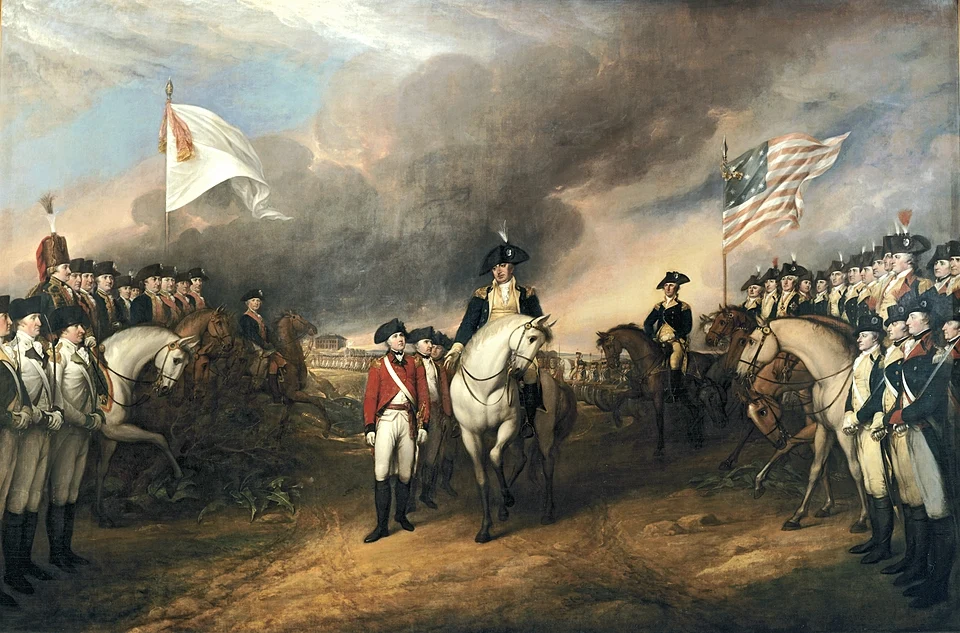
On November 25, 1783, British forces departed New York City for the final time, following the signing of the Treaty of Paris. This momentous occasion marked the definitive conclusion of the American Revolutionary War and affirmed the promise set forth in the Declaration of Independence.
The Revolutionary War
What began as a dispute between Great Britain and its 13 North American colonies would eventually reshape the world. Growing resentment over British taxation and governance fueled the colonists' burning ambition to forge their own independent nation. Before long, the struggle expanded well beyond North American shores, drawing in other nations such as France, Spain, and Germany and transforming it into a truly global conflict.
Tensions boiled over on April 19, 1775, when the Battles of Lexington and Concord erupted — the moment widely recognized as the revolution's official beginning. The British Parliament had enacted laws levying direct taxes on colonists, sparking fierce resistance throughout the colonies. When British soldiers advanced into Concord with orders to confiscate colonial supplies and crush the growing rebellion, they were met by armed colonial militia. That fateful clash set the course for the long fight toward American independence.
For nearly a decade, the struggle raged on, with hostilities persisting until September 1783. Interestingly, the American Revolutionary War is often characterized as a civil war — it is estimated that roughly one-third of colonists sided with the British army, and at no point did even 50 percent of the colonial population rally behind the revolutionary cause. Communities fractured as neighbor turned against neighbor, and devastating bloodshed followed on both sides. Yet through all the hardship and tragedy, the colonists held firm. Victory came in 1783, and with it, the birth of America as a sovereign nation.
A Historic End
The guns of the American Revolution fell silent on October 19, 1781, when British General Cornwallis laid down his arms and surrendered to George Washington and his forces. In the aftermath, both sides hammered out terms of surrender, opening the door to formal peace negotiations between Great Britain and the colonies. The Treaty of Paris, signed on September 3, 1783, brought the Revolutionary War to its official close by recognizing American independence and drawing the boundaries of the fledgling nation. That said, many regard November 25, 1783, as the genuine end of the war — the day the last remaining British troops left United States soil with their withdrawal from New York City.
Symbolic Significance
New Yorkers came to know November 25 as "Evacuation Day," and for years afterward, the anniversary was marked with spirited parades, dazzling fireworks, and lively parties. It stood as a powerful symbol of triumph over one of the world's mightiest empires. The tradition of officially celebrating Evacuation Day faded during World War I, when many felt it was unseemly to commemorate the departure of what were now British allies. Even so, the date endures in memory as a deeply meaningful chapter in the story of American independence.