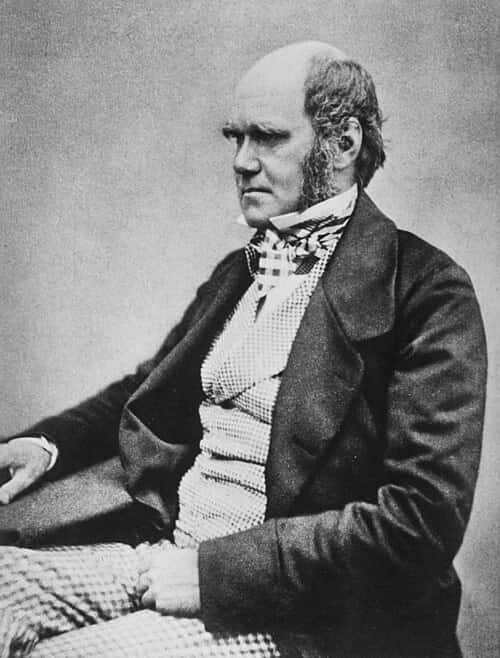
The world was forever altered by the work of Charles Darwin, a 19th-century English naturalist whose bold ideas shook the foundations of science. When he released his book, On the Origin of Species, on November 24, 1859, he upended the prevailing scientific understanding of biology. In its pages, he laid out a framework for how living organisms and all of Earth's creatures adapt and evolve over time in order to survive. To this day, the revolutionary concepts he introduced remain a subject of vigorous debate.
Early Life
Born in 1809 into a prosperous and prominent English family, Charles Darwin was one of six children — the fifth, to be precise. His father, a highly regarded doctor in the community of Shrewsbury, provided a comfortable upbringing. Even as a young boy, Darwin was captivated by the natural world and everything it had to offer. He spent his time gathering rocks and insects for closer examination, and by the age of 13, he had gone so far as to convert his family's garden shed into a personal laboratory where he could investigate his surroundings.
Recognizing this budding passion for science, Darwin's father steered him toward a medical career. He began his education at the University of Edinburgh Medical School, yet he couldn't stomach the reality of surgical procedures and eventually dropped out. From there, he made his way to Christ's College in Cambridge, where he originally planned to train as an Anglican parson. But the pull of the outdoors proved far stronger than his devotion to coursework. It was his Cambridge professors who nurtured and championed his growing love of the natural world.
A Life-Changing Voyage
A pivotal opportunity arrived in 1831, when Charles Darwin received a recommendation to join the HMS Beagle as an unpaid naturalist. The vessel's captain had set out to chart the coastline of South America, and while the expedition's main purpose was navigational rather than scientific, Darwin was welcomed on board to carry out his own research. What was originally expected to be a two-year journey stretched into a five-year odyssey that ultimately took the crew around the entire globe.
For Darwin, this experience was nothing short of transformative — he called it the "most important event in his life." The voyage supplied him with invaluable evidence that would bolster a theory taking shape in his mind: that all living things adapt and evolve over time.
Three years after stepping off the HMS Beagle, Charles Darwin brought On the Origin of Species to the world on November 24, 1859. Through this landmark publication, he presented his theories of evolution by natural selection to the scientific community and the broader public alike. At the heart of his argument was the idea that every species evolves as individuals possessing the most beneficial genetic variations are the ones that survive. The extensive data he had gathered during his five-year expedition served as the backbone of his claims.
Controversial Impact
Darwin's publication was met with a remarkable blend of commercial triumph and fierce controversy. Every copy sold on its very first day, yet public opinion was sharply divided. While much of the scientific community rallied behind his ideas, religious groups saw the work as a direct challenge to biblical teachings. Heated debate and pointed criticism followed, though substantial praise came along with it. But no matter where one stood on the controversy, there was no denying the seismic effect On the Origin of Species had on the field of biology. The fundamental principles Darwin outlined in its pages remain the bedrock of modern biological science to this day.