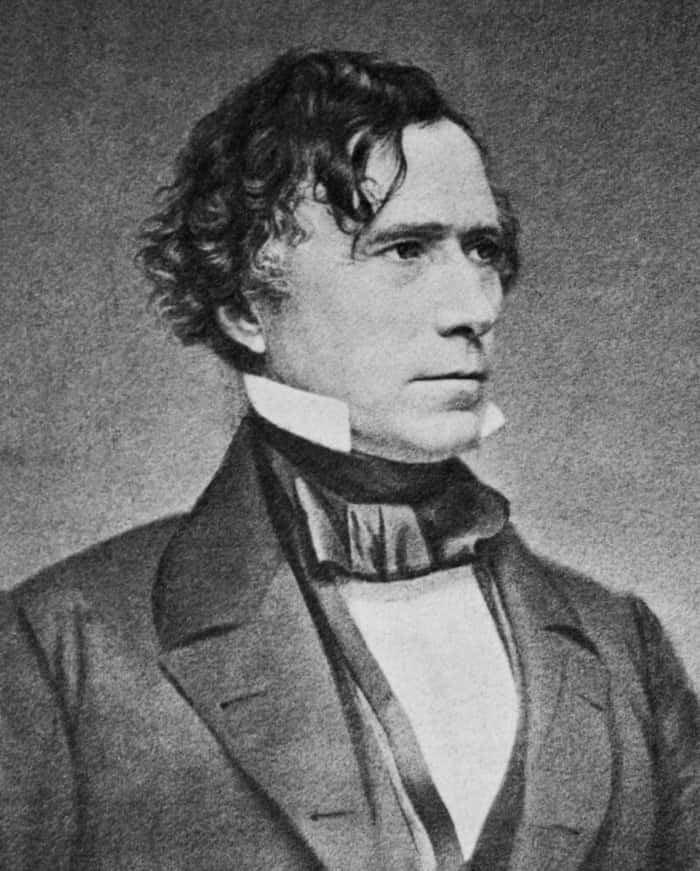
On November 23, 1804, in Hillsborough, New Hampshire, a future president entered the world under humble circumstances. Franklin Pierce would eventually climb the political ladder to serve as the 14th president of the United States, guiding the nation during one of its most turbulent chapters. As friction between Northern and Southern states reached a fever pitch, his time in office became a defining — and deeply contested — era. The choices he made amid these mounting crises have left behind a layered legacy, one that scholars still debate as they weigh the lasting consequences of his leadership.
Fun Facts:
- Early Life and Career: A driven and intellectually gifted young man, Pierce enrolled at Bowdoin College, where he cultivated enduring friendships — most notably with celebrated author Nathaniel Hawthorne. Following his legal studies, he wasted little time making his mark in the political arena, rising through the ranks as a New Hampshire legislator, then a U.S. Congressman, and ultimately a U.S. Senator. These formative connections and early career experiences proved instrumental in shaping the political convictions and choices that would define his future.
- Military Service: When the Mexican-American War broke out, Pierce took on the role of brigadier general. His time in uniform wasn't without its difficulties, yet his military service nonetheless elevated his public profile and bolstered his standing in political circles — factors that helped propel him toward the presidential nomination in 1852.
- Presidency (1853–1857): Territorial expansion stood at the center of Pierce's agenda as president, but it was his backing of the Kansas-Nebraska Act that proved most consequential. By permitting territories to determine the slavery question for themselves, the legislation deepened the rift between the nation's sections. Widely regarded as a defining episode of his administration, the act sparked violent upheaval in Kansas and drove the country ever closer to Civil War — a stark reminder of just how far-reaching his decisions proved to be.
- Legacy: Pierce's position on slavery, coupled with his signing of the Kansas-Nebraska Act, cemented his reputation as one of the more polarizing figures to occupy the White House, particularly as the nation hurtled toward armed conflict. Once his presidency concluded, he stepped away from public life, yet the debate surrounding his record only intensified. Historians have long scrutinized his failure to defuse the mounting national crisis, and this persistent controversy speaks to the enduring uncertainty over where Franklin Pierce truly belongs in the annals of American history.