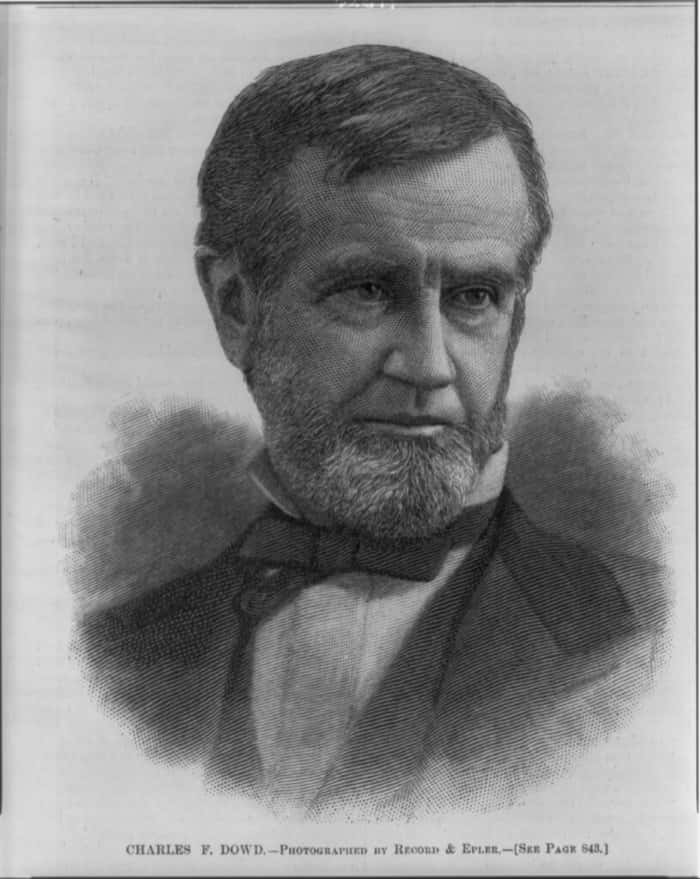
Before Charles F. Dowd came along with his groundbreaking proposal on November 18, 1883, keeping track of time across the United States was an absolute mess. As an educator, Dowd put forward a revolutionary idea: standardized time zones. His system tackled the widespread disorder caused by countless conflicting local times, ushering in a dramatically more organized way of doing things. The impact was immediate for railroad scheduling across the nation, but the ripple effects extended far beyond — transforming travel and communication efficiency on a worldwide level.
Fun Facts:
- The Railroad Dilemma: Picture this: every single town in America setting its clocks based solely on where the sun happened to be overhead. That was everyday life before time zones existed, and for the railways, it was a nightmare. With trains crossing through dozens of different local times, scheduling headaches and dangerous accidents were commonplace. Dowd's proposed system offered the desperately needed order to cut through all that confusion.
- Dowd's Vision: Charles F. Dowd wasn't just any thinker — he was a college principal and a passionate champion of standardized time. On this day in 1883, he put forward his proposal to split the country into four distinct time zones. Railroad companies would eventually refine and embrace his concept.
- "The Day of Two Noons": Why did November 18, 1883, earn the memorable nickname the "Day of Two Noons"? Because as railroads and cities across the country reset their clocks to fall in line with Dowd's new time zones, each zone wound up experiencing noon at a slightly different moment — giving some places two noons in a single day.
- World Influence: What started as a fix for an American problem quickly became something much bigger. Dowd's concept provided the intellectual foundation for the International Meridian Conference in 1884, which established the global standard time system still in use today. The fact that worldwide timekeeping traces back to Dowd's time zones speaks volumes about the far-reaching significance of his contribution.
- Enduring Legacy: Despite never receiving formal recognition for his pivotal role, Dowd's influence on the modern world is unmistakable. The timekeeping framework he established underpins everything from international trade to aviation schedules. Every coordinated meeting that starts on time, every flight that departs as planned — each one is a quiet tribute to the lasting legacy of Charles F. Dowd.