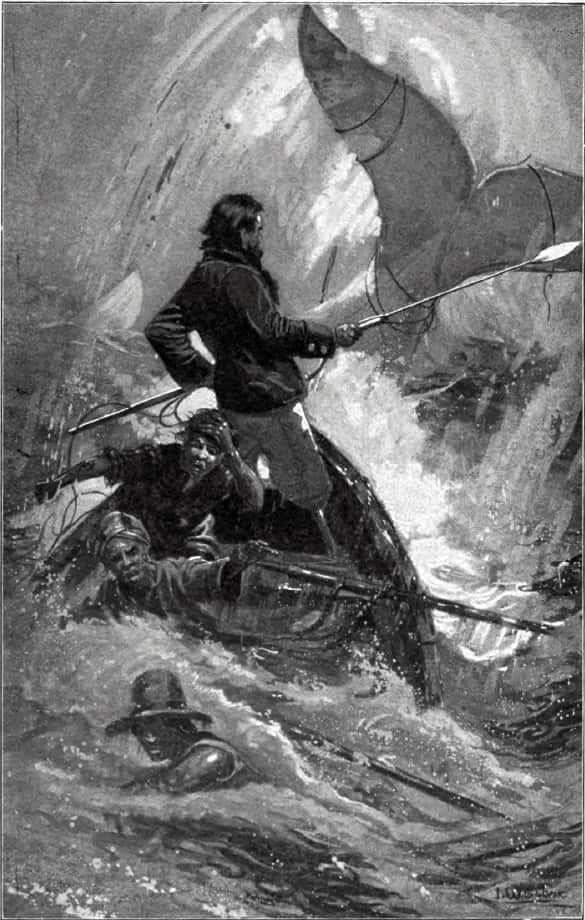
Few American writers have had a more dramatic posthumous reversal of fortune than Herman Melville, an adventure novelist and short story writer whose time as a sailor on the Pacific Ocean deeply shaped his literary output. Though he is now celebrated as the creator of the Great American Novel, Moby-Dick, the book was anything but a hit when it first appeared. On November 14, 1851, his publishing company Harper & Brothers gave their grudging approval to release the novel in the United States.
An Author's Inspiration
Born in 1819 in New York City, Herman Melville grew up in a household crushed by severe debt and poverty. When his father died, the young Melville had no choice but to leave elementary school at the age of 12, taking on the burden of helping to provide for his family. Steady employment proved elusive until he landed a position as a deckhand on a merchant ship — and that changed everything. He discovered a deep love for the open sea and kept pursuing work aboard merchant and whaling ships. While the wages he earned went toward supporting his brothers and sisters at home, his time on the water would ultimately serve a far greater purpose in his life.
Writing was Herman Melville's true passion, yet it was hardly a reliable way to make a living, particularly for someone who desperately needed a steady income. Still, Melville refused to give up. Once he began mining his real-life experiences at sea for material, his literary career took off. Drawing on his maritime adventures, he produced several novels, 17 short stories, and a wealth of poems, building a considerable readership along the way.
Initial Publication
After years of painstaking effort, Herman Melville delivered a new manuscript to his American publishing company, Harper & Brothers, in 1851. This was no ordinary adventure tale — it was a sprawling philosophical epic about a sea captain named Ahab, consumed by his obsession with hunting down a giant sperm whale that had previously taken his leg. Dense with symbolism and considerably darker than anything the publishing company had come to expect from Melville, the novel was titled Moby-Dick and rooted in the author's real-life experiences, just as many of his successful works had been. The publishers, however, were far from enthusiastic.
Harper & Brothers resisted Moby Dick strongly, convinced it would fail to connect with Melville's established audience. Nonetheless, they went ahead and published it on November 14, 1851, several weeks after the British edition — released under the title The Whale — had already appeared.
A Flop Turned Classic
The public's response to Moby Dick was deeply disappointing. Harper & Brothers had been right to worry — Melville's readership recoiled from the dark, complex narrative, and the novel proved a commercial failure. Critical reception was mixed, leaning heavily toward the negative.
The harsh criticism left Melville devastated, shaking his confidence in both his writing and his budding literary career. He gradually faded into obscurity and never produced another successful work.
It wasn't until the beginning of the 20th century, well after Melville had passed away, that Moby Dick found new life through the "Melville Movement." A dedicated group of literary scholars conducted a thorough reevaluation of his body of work, and the novel finally earned recognition as a literary masterpiece. Ever since, Moby Dick has been regarded as a classic and considered essential reading for anyone studying American literature.
Melville himself never witnessed the remarkable revival and appreciation that his masterpiece eventually received. Yet his legacy endures, as each year brings a fresh wave of readers ready to join Captain Ahab on his obsessive quest.