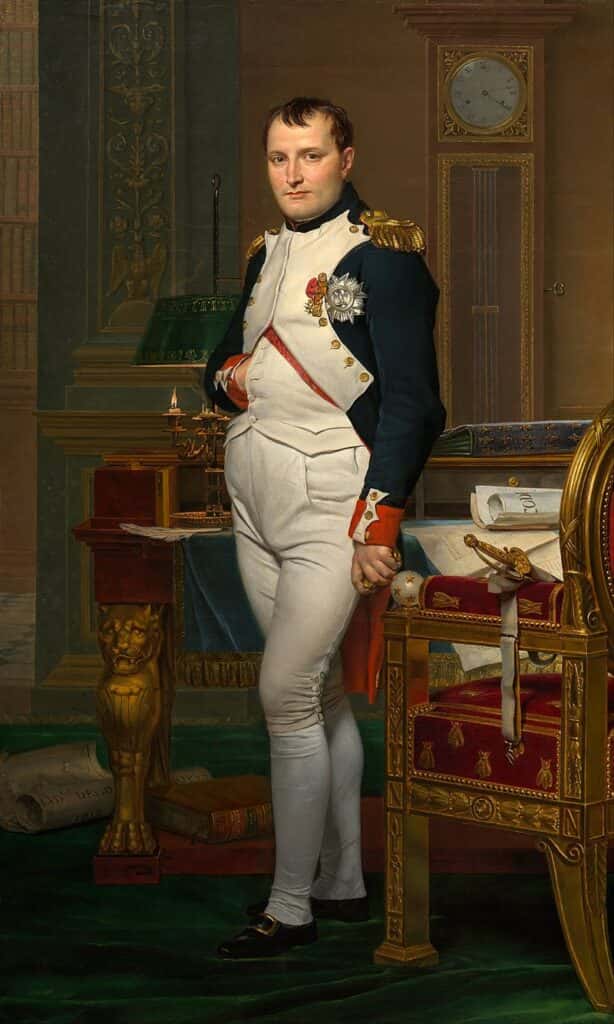
On the remote South Atlantic island of St. Helena, Napoleon Bonaparte spent his final years after the British government banished him there following his decisive defeat at the Battle of Waterloo. The location was chosen deliberately — its extreme isolation, they reasoned, would make it impossible for him to orchestrate any new rebellions or threaten the hard-won peace. As it turned out, they were right. Napoleon died on May 5, 1821, having endured five years of exile on that distant outpost.
Few figures in history have sparked as much admiration and controversy as Napoleon Bonaparte, the French general who rose to prominence during the French Revolution. A combination of brilliant military strategy and relentless ambition propelled him through the ranks at a remarkable pace. Under his command, France achieved major victories that extended its imperial reach across the European continent. In 1799, he orchestrated a coup to seize control of the government and ultimately declared himself Emperor, concentrating supreme power in his own hands. What followed was a sweeping series of European conflicts that came to be called the Napoleonic Wars. Beyond the battlefield, he also introduced the Napoleonic Code in 1804 — a landmark effort to bring French law under a single, unified framework that applied equally to all people under his authority.
Twice during his lifetime, Napoleon found himself captured and sent into exile. The first banishment came in 1814, when Coalition Forces pressured him into giving up the throne. He was dispatched to the island of Elba, where the Treaty of Fontainebleau granted him sovereignty — effectively making him Emperor of the small island. Yet Elba could not contain him for long. After just over a year, he managed to escape and make his way back to France, triggering the dramatic episode known as the Hundred Days. That comeback was short-lived, though: defeat at the Battle of Waterloo sealed his fate, and this time his exile to St. Helena was permanent.
Napoleon passed away on May 5th, 1821, at age 51, after nearly six years confined in exile. His final years were marked by a mysterious illness that progressively worsened until he was completely bedridden. Desperate appeals were made — both by Napoleon himself, who pleaded for his release, and by his doctors, who warned that the combination of exile and his deteriorating condition would prove fatal. The Allied powers, however, turned a deaf ear to every request. When an autopsy was performed after his death, it revealed the cause: stomach cancer.