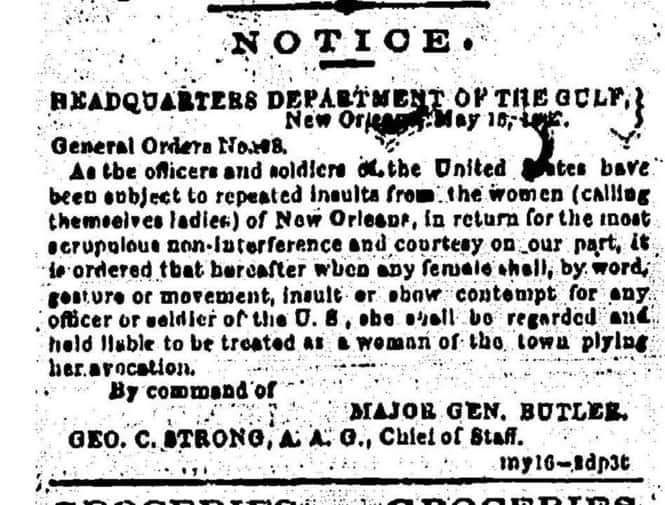
When Union forces under Major General Benjamin F. Butler marched into New Orleans in May of 1862, they were met with open hostility from the city's residents. Civilians — men and women alike — hurled insults at the occupying soldiers, and some encounters even turned violent. Just two weeks after the troops arrived, on May 16, 1862, Butler responded with a controversial directive: General Order No. 28, which quickly became known as the "Woman's Order." Its purpose was to govern how soldiers and civilian women interacted, though the measures it prescribed would ignite fierce debate.
What made the Woman's Order so provocative was its striking and unconventional language. Under its terms, any woman who displayed contempt toward a soldier would be treated as though she were soliciting prostitution. While this wasn't necessarily meant to carry a sexual connotation, the practical effect was that soldiers could regard and treat such women as something other than "ladies." If a woman spat on a soldier, for instance, the order gave him permission to respond in kind. Beyond that, women who engaged in such hostile behavior could also face legal consequences under the directive.
The backlash was swift and widespread, echoing far beyond New Orleans across both the United States and the international stage. Critics argued that the order effectively gave soldiers license to commit rape. President Jefferson Davis of the Confederate States publicly denounced Major General Butler, who found himself despised by civilians in Confederate and Union territories alike. So deep was the contempt for him that portraits of Butler reportedly ended up decorating the bottoms of chamber pots! Despite Butler's own claims that the order successfully curbed harassment directed at his troops in New Orleans, his tenure didn't last much longer. By December of 1862, he had been relieved of his command, and General Order No. 28 came to an effective end.