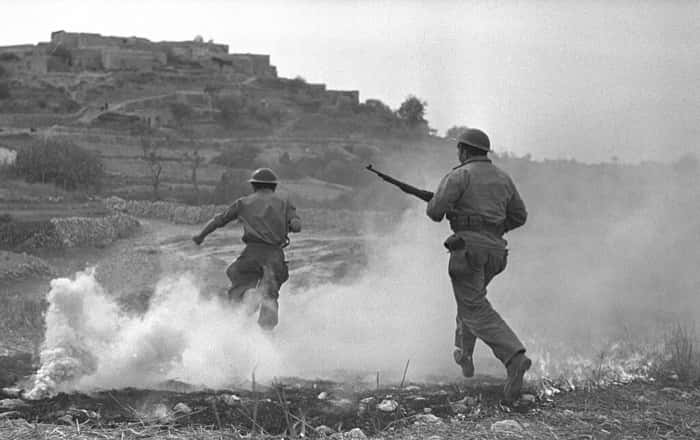
The eruption of the first Arab-Israeli conflict on May 15, 1948, stands as one of the most consequential turning points the Middle East has ever witnessed. To understand why, you have to look at what happened just one day earlier: on May 14, David Ben-Gurion proclaimed Israel's independence, bringing to fruition a dream the Jewish people had carried through centuries of dispersion and roughly four decades of organized Zionist advocacy.
The reaction from neighboring Arab states was swift and fierce. Almost immediately after Israel declared statehood on May 14, 1948, a coalition comprising Egypt, Transjordan (now Jordan), Syria, Lebanon, and Iraq mounted coordinated military strikes against the newborn nation. Their unified objective was twofold: to destroy the young Jewish state and to bolster Palestinian Arab groups who had refused to accept the United Nations Partition Plan.
What followed was a rapid and dramatic escalation. Arab forces initially gained ground, but Israel mounted a determined counterattack, drawing on its resources and international backing to push back effectively. Israeli troops leveraged their successful defensive operations to extend their territorial control beyond the boundaries drawn by the UN partition during the course of the fighting. Although armistice agreements reached in 1949 brought the Arab-Israeli War to a formal close, the fallout was anything but finished. Hundreds of thousands of Palestinians found themselves displaced, and the conflict planted the seeds for decades of unresolved tensions, subsequent wars, and an enduring struggle over land and national identity.
For Palestinians, May 15 carries a deeply painful significance that goes beyond the outbreak of war. It is observed as Nakba Day — "Catastrophe" in Arabic — a solemn occasion of mourning for those who were uprooted from their homes and homeland in the wake of Israel's establishment.
The events set in motion on May 15, 1948, fundamentally redrew the map of the Middle East, and their reverberations remain at the heart of historical and political debate to this day. What began as the opening chapter of a war evolved into an unfinished story — one that continues to shape an entire region and define its trajectory.