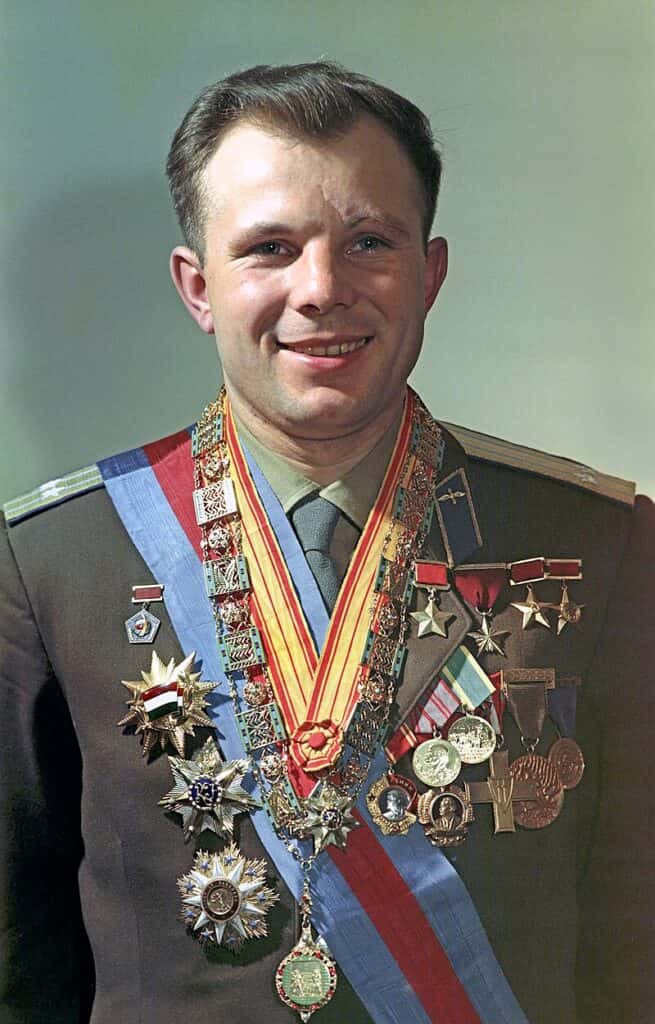
On March 9, 1934, in the tiny village of Klushino in western Russia, Yuri Alekseyevich Gagarin came into the world. His parents, Anna Timofeyevna and Alexei Ivanovich Gagarin, raised him on a collective farm. It was the unexpected landing of a Yak fighter plane near his home that first sparked the young boy's deep fascination with flight.
Gagarin's path toward the skies took shape after he finished an apprenticeship in foundry work at a metalwork facility. He enrolled in a technical high school in Saratov, where he also joined the 'Aeroclub' and learned to fly light aircraft. His love of aviation proved impossible to ignore, propelling him to the Orenburg Military Pilot's School in 1955. From there, he moved on to the Soviet Air Force cadet school in Orenburg, earning his pilot certification in 1957. Along the way, he married Valentina Ivanova Goryacheva. By 1959, his unwavering commitment to flying caught the attention of the Soviet space program's recruiters, and out of countless applicants, Gagarin was selected thanks to his aptitude and tenacity.
History was forever changed on April 12, 1961, when Gagarin became the first human being to travel into space. Strapped inside Vostok 1, he orbited the Earth at a staggering 28,000 kilometers per hour over the course of a 108-minute flight — ushering in the era of human space exploration. The achievement transformed him into not just a pioneer but a worldwide ambassador for space travel. Back at Star City, he channeled his experience into designing spacecraft and mentoring the next generation of cosmonauts. The U.S.S.R. honored his remarkable contributions by promoting him to lieutenant colonel in June 1962 and subsequently to colonel in November 1963. Heartbreakingly, Gagarin's life was cut short on March 27, 1968, when he perished during a routine training flight in a MiG-15 fighter plane.
Legacy
Far more than a triumph for the Soviet Union alone, Gagarin's voyage into space stands as a defining moment for all of humanity and our capacity to reach beyond Earth. That 108-minute flight on April 12, 1961, remains one of the great milestones in human history. To honor his memory, his hometown of Gzhatsk was renamed Gagarin, and the crew of the Apollo 15 mission left a plaque on the lunar surface commemorating him alongside other trailblazers who helped guide humanity into the cosmos. To this day, Gagarin's name remains inseparable from the spirit of exploration, continuing to inspire generations around the world.