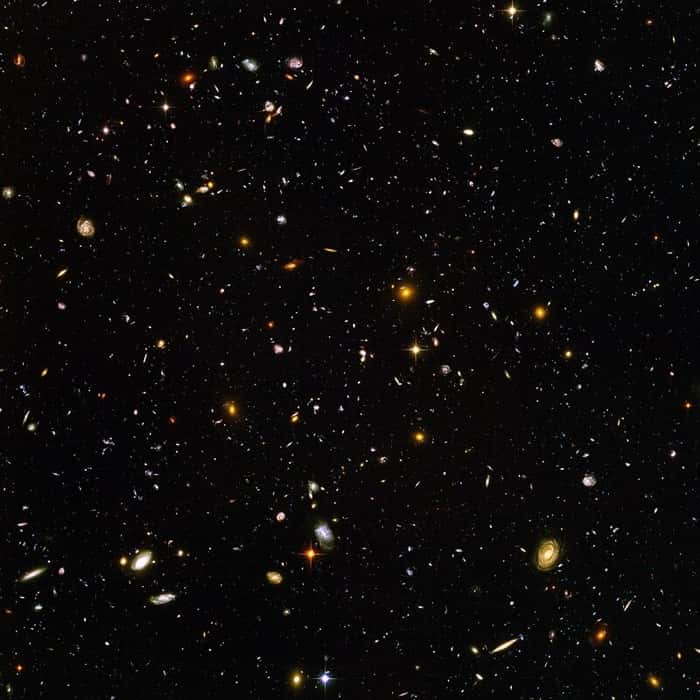
Back in 1934, on this very day, astronomer Edwin Hubble unveiled a finding that would forever alter humanity's place in the cosmos: galaxies existed far beyond the boundaries of our Milky Way. What made this revelation so staggering was his research showing that the number of these galaxies rivaled the number of stars within our own galaxy — a realization that fundamentally reshaped how we think about the universe and launched entirely new directions for scientific exploration.
Before this breakthrough, astronomers peering through their telescopes could only make out what appeared to be clusters of stars grouped together. However, by carefully studying photographs captured through his telescope at the Mount Wilson Observatory in California, Edwin Hubble was able to determine that these apparent star clusters were, in fact, whole galaxies existing independently of our own. He went further still, calculating that these galaxies were speeding away from us at rates directly tied to how far away they were — a relationship that came to be called "Hubble's Law". The implications were profound: the more distant a galaxy, the faster its retreat from us, a principle that unlocked a wealth of fascinating new questions for cosmological investigation.
The significance of this achievement cannot be overstated. Prior to what Edwin Hubble demonstrated, the prevailing assumption held that all interstellar matter resided within the Milky Way. Astronomy textbooks from just a few years before had classified these objects as "nebulae" situated inside our galaxy. Hubble proved otherwise — these nebulae were standalone galaxies, and their sheer number exceeded anything previously conceived. This dramatic expansion of scientific knowledge gave humanity an entirely fresh perspective on the nature of outer space.
The ripple effects of his trailblazing work transformed the field of astronomy, illuminating both the structure and evolution of the universe in unprecedented ways. Building on his advancements, astronomers gained deeper insight into complex phenomena like dark energy and vast galactic architectures such as superclusters and filaments, not to mention planets lying well beyond our solar system. Edwin Hubble's contributions truly opened the world's eyes to just how vast and intricate the cosmos really is.
Edwin Hubble is honored today for a discovery that proved to be a catalyst for countless advances in cosmological science. By pushing the boundaries of what was known, he revealed to the world the remarkable possibilities that still await discovery.