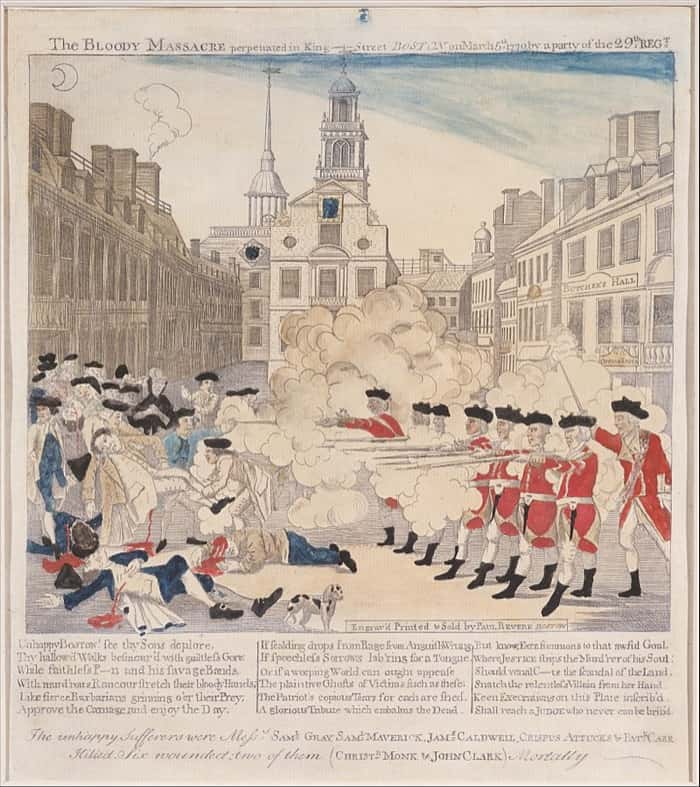
On this date in history, the streets of Boston became the stage for a deadly confrontation that would help set the American colonies on an irreversible path toward independence. The evening of March 5, 1770, saw a tense standoff between a group of British Redcoats and a furious colonial mob spiral into bloodshed — a tragedy destined to reshape the trajectory of an entire nation.
Colonial frustration with British authority had been building to a breaking point by 1770. Ever since British troops arrived in Boston in 1768 to enforce widely despised taxation laws, resentment among the colonists had only intensified. On that fateful night, a gathering of colonists assembled outside the Customs House, hurling insults and provocations at the British sentries standing guard. Many in the crowd identified as Patriots and viewed the soldiers as instruments of oppression. As tensions mounted and the mob swelled, British Captain Thomas Preston, responsible for keeping the peace, called for reinforcements. The increasingly hostile crowd began pelting the soldiers with snowballs, ice, and debris. Among the Redcoats was Private Hugh Montgomery, who — along with his fellow soldiers — found himself under growing duress and genuinely feared for his safety. After being struck, Montgomery discharged his weapon into the crowd, acting in what he perceived as self-defense. Within moments, several other soldiers, equally alarmed, opened fire as well.
The aftermath was devastating: five colonists were left dead or mortally wounded. Crispus Attucks, a man of African and Native American heritage, was among the fallen and would become an enduring and potent symbol of the Patriot movement. The other victims — Samuel Gray, Samuel Maverick, James Caldwell, and Patrick Carr — also perished in the violence.
Ripples from the incident spread rapidly across the colonies. The accused British soldiers were brought to trial, with their legal defense mounted by an unlikely figure — John Adams. Despite his well-known Patriot leanings, Adams held firm in his conviction that every person deserved a fair trial. The proceedings concluded in December 1770 with two soldiers, Private Hugh Montgomery among them, found guilty of manslaughter; their punishment was branding on their thumbs. The trial carried deep significance, showcasing the colonies' commitment to the rule of law. Meanwhile, Patriot figures like Samuel Adams and Paul Revere wasted no time weaponizing the incident for propaganda purposes. Revere produced his now-iconic engraving, which portrayed British soldiers callously gunning down defenseless colonists — a brilliant piece of image-making that profoundly shaped how the public understood the event. The phrase "Boston Massacre" itself was deliberately chosen to etch the tragedy into the American consciousness as proof of British tyranny.
The American Revolution wouldn't formally erupt for another five years, yet the Boston Massacre stands as a pivotal moment in the march toward war. It laid bare the deepening rift between Britain and its colonial subjects — a chasm that would soon prove impossible to bridge. By shifting public sentiment decisively against British rule, the massacre stoked the revolutionary fervor that would ultimately ignite a fight for independence.