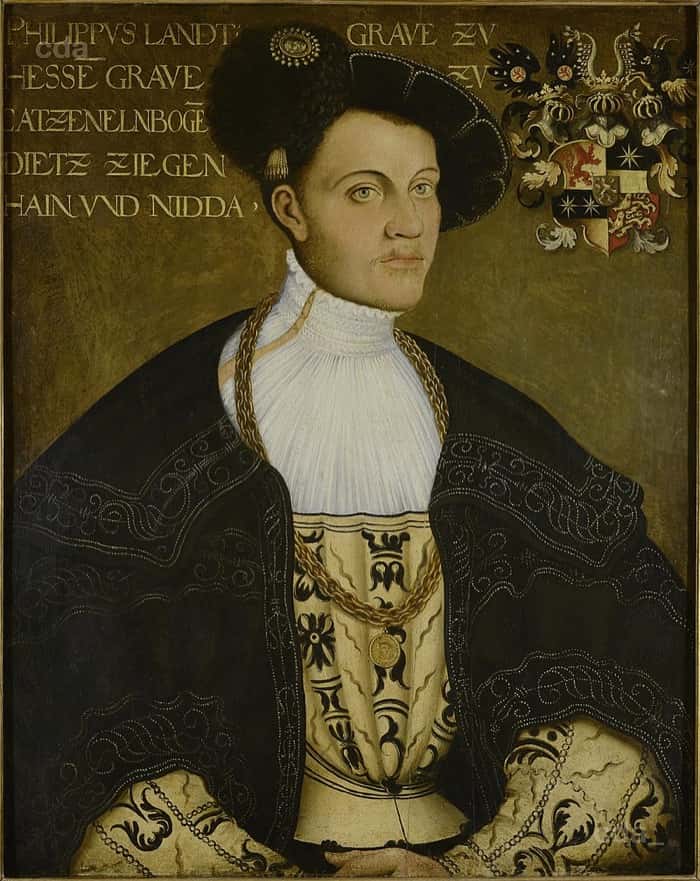
On March 4, 1540, Protestant Count Philip of Hessen entered into a bigamous marriage with Margarethe von der Saale, triggering what would become one of the most explosive scandals in German history. The shockwaves from this union rippled through society, threatening to destabilize law and order across the region and laying bare just how deeply personal decisions could shake the foundations of public life.
A German nobleman of considerable influence, Philip I, Landgrave of Hesse is perhaps best remembered for the pivotal part he played in the Protestant Reformation. His father died when Philip was only five years old, sparking a power struggle with his mother, who had assumed the role of regent on his behalf. A turbulent childhood marked by family strife meant that Philip never received the kind of religious and moral education that was standard for someone of his station during that period. As he grew older and began charting his own course, a fateful encounter with Martin Luther at the age of 17 proved transformative. Three years after that first meeting, Philip formally embraced Protestantism—a shift driven by his mounting disillusionment with Catholic Church teachings and his own personal reading of the Bible.
On December 11, 1523, Philip entered into an arranged marriage with Christine of Saxony, a strategic alliance designed to bind the houses of Hesse and Saxony together. Though the couple went on to have ten children, Philip was reportedly "disgusted" by his wife and soon found himself drawn to another woman—Margarethe von der Saale. What followed was a relationship that Martin Luther himself characterized as a constant state of "adultery and fornication." Philip recognized the sinfulness of adultery, yet he refused to pursue divorce, viewing it as an equally sinful path. Caught between these two moral failings, he ultimately sought and received Martin Luther's blessing in 1539 to take Margarethe von der Saale as a second wife, with Luther reasoning that bigamy was the lesser of the two evils compared to divorce. The couple wed on March 4, 1540.
When word spread that Count Philip had taken a second wife while still married to his first, public fury erupted. This was a flagrant violation of both Roman Catholic teachings and the civil laws of the land. Making matters even more incendiary was the revelation that Margarethe was actually the niece of his first wife. This brazen flouting of religious and legal conventions ignited widespread condemnation from clergy and common people alike, who saw it as a direct assault on the sanctity of family structure and long-held traditions.
The fallout didn't stop with public outrage—it galvanized regional leaders into action against Count Philip. Despite holding divergent views on many matters, prominent figures including George III of Anhalt-Dessau, Landgrave William IV of Hesse-Kassel, Julius III of Brandenburg, and John George I of Saxony banded together in vocal opposition, united by their determination to see justice done in the wake of this extraordinary marital scandal.