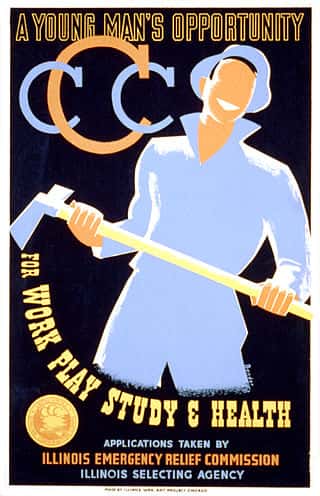
In the depths of the Great Depression, President Roosevelt brought the Civilian Conservation Corps into existence on March 31, 1933. The program served a dual mission: putting Americans back to work while safeguarding the nation's natural resources.
At its core, the CCC was designed to tackle unemployment by channeling young men into vital conservation projects across the country. Enrollees threw themselves into a wide range of tasks — planting trees, building flood barriers, fighting forest fires, and keeping forest roads and paths in good condition. The sheer magnitude of tree planting carried out during the program's nine-year run was staggering: over 2 billion trees went into the ground, earning the initiative the beloved moniker 'Roosevelt's Tree Army'. This enormous reforestation campaign played a critical role in combating soil erosion, deforestation, and the Dust Bowl.
The typical CCC worker was an unemployed male between the ages of 18-25, living in military-style camps and earning $30 a month — of which $25 was sent home to support their families. Beyond the paycheck, the program gave its participants discipline, structure, and a renewed sense of purpose. By 1942, the ranks had swelled to include almost 3 million men and approximately 8,500 women. While the camps technically welcomed all races, the reality of prevailing racism meant they were separated. Even so, approximately 250,000 African Americans and approximately 80,000 Native Americans served — a powerful testament to their resilience against discrimination. It wasn't until 1941, as white membership declined, that Black laborers were actively recruited.
As one of the most influential New Deal initiatives, the CCC left a profound mark on America by generating employment, enhancing the environment, and laying the groundwork for future conservation efforts. Though the program came to an end in 1942, its impact lives on — particularly in ongoing struggles against inequality and climate change. Across the country, national parks, trails, and infrastructure projects built by CCC hands still stand today.