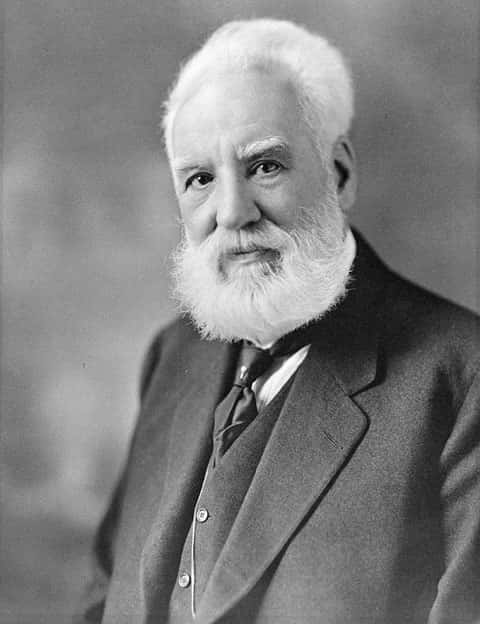
On March 3, 1847, in Edinburgh, Scotland, the world welcomed Alexander Graham Bell — a man who would go on to transform the very fabric of human communication. Best known for inventing the telephone, his pioneering work reshaped how people across the globe connect with one another, leaving an enduring mark that resonates to this day.
From an early age, Alexander Graham Bell was surrounded by a family deeply immersed in the study of speech and sound. His grandfather, Alexander Bell, worked as an elocutionist, while his father, Alexander Melville Bell, held a prominent position in the field of phonetics and took charge of educating young Bell at home. Growing up in this environment, Bell developed a powerful fascination with acoustics and communication — interests that would ultimately fuel his life's work. He went on to attend Edinburgh's Royal High School, though at fifteen he left school to spend a year living with his grandfather in London. By 1864, Bell had taken up a role as a "pupil-teacher" of music and elocution at Weston House Academy in Elgin, Moray.
Bell's restless curiosity and scientific talent led him to the University of Edinburgh and subsequently University College London, though he never completed a degree at either institution. During the 1870s, he relocated first to Canada and then to the US, where he deepened his research into speech and sound. By 1872, he was already experimenting with transmitting multiple telegraph signals over a single line. Working alongside his assistant, Thomas Watson, Bell had developed a telephone prototype by 1875, and on March 7, 1876, he secured a patent for the device. The following year, in 1877, he established the Bell Telephone Company — an enterprise that would eventually grow into AT&T. Then, in 1915, Bell achieved yet another milestone by placing the first official transcontinental call, connecting once again with Watson.
The scope of Alexander Graham Bell's impact stretched well beyond telecommunications. His wide-ranging curiosity drove him to make notable contributions in both aviation and hydrofoil technology, showcasing a remarkable breadth of scientific interest. He was also instrumental in transforming education for deaf people. Adding still another dimension to his legacy, Bell co-founded the National Geographic Society in 1888, solidifying his reputation as a trailblazer across multiple disciplines.